Heritage & Reconstruction in Nineveh.
A 12th-century minaret that leaned over Mosul for 850 years, blown up in June 2017 and stone-by-stone rebuilt by 2024; a Dominican convent and a Syriac Catholic church whose bells rang again in September 2025; a museum whose lamassu were smashed on video in 2015 and whose fragments are now being reassembled one piece at a time; 124 heritage houses rehabilitated under UNESCO's most ambitious post-conflict programme. The destruction and the rebuilding, in detail.
The destruction of cultural heritage in Mosul between 2014 and 2017 was not collateral damage. It was, in most cases, deliberate: a programme of erasure executed by the occupying authority against the religious, archaeological, and architectural monuments that defined the city's identity as a place where Sunni Muslims, Shia, Christians, Yazidis, Turkmen, Kurds and Mandaeans had lived in one urban fabric for centuries. The Al-Nūrī Mosque and its Al-Hadbāʾ minaret — the city's most recognisable silhouette, on the back of the 10,000-dinar banknote — were destroyed on the night of 21 June 2017. The Al-Saa'a Convent and Al-Tahera Church were looted and shelled. The Mosul Museum's galleries were demolished on video in February 2015. The Old City's traditional courtyard houses were systematically wrecked. Forty-five tombs and shrines were levelled across the Governorate. The Yazidi temples of Sinjar were desecrated; ancient Assyrian sites at Nineveh, Nimrud and Khorsabad were bulldozed.
The post-2017 reconstruction has been substantial. The Al-Nūrī Mosque and the Al-Hadbāʾ minaret were officially reopened on 1 September 2025. The Al-Saa'a Convent's interior was completed in February 2024 and its bells inaugurated with the mosque. Al-Tahera Church was handed back to the Syriac Catholic community in September 2024. The Mosul Museum is on schedule for a 2026 reopening. One hundred and twenty-four heritage houses have been rehabilitated using traditional materials. This entry sets out, monument by monument, what was lost, what has been rebuilt, by whom and at what cost, and what remains.
i. Overview & the UNESCO initiative
The principal vehicle for Mosul's heritage reconstruction has been UNESCO's Revive the Spirit of Mosul initiative, launched in February 2018 at the Kuwait International Conference for the Reconstruction of Iraq. The initiative is, by some measures, the most ambitious post-conflict cultural-recovery programme UNESCO has ever undertaken. Its three declared pillars are heritage, cultural life, and education; this entry concerns the first. The total programme has mobilised US$115 million from 15 partners. The largest single contributor is the United Arab Emirates, with US$50.4 million committed in April 2018 for the Al-Nūrī Mosque, Al-Hadbāʾ minaret, the Al-Saa'a Convent and its House of Prayer, and the Al-Tahera Church. The European Union followed with €20 million; further contributions have come from the Republic of Korea, Germany, France, the United States, and other governments. Iraqi co-financing has been provided through the Ministry of Culture and the State Board of Antiquities and Heritage (SBAH).
Two further frameworks complement the UNESCO initiative. The first is the International Alliance for the Protection of Heritage in Conflict Areas (ALIPH), founded in 2017 at French and Emirati initiative; ALIPH made the rehabilitation of the Mosul Museum its signature project at its founding, with a first grant of $1.3 million expanding to $15.8 million total commitment for the Museum alone. The second is the bilateral programme of cultural-property protection administered by the United Arab Emirates Ministry of Culture and the federal Iraqi authorities under the 2019 "Year of Tolerance" agreement, which added the Al-Saa'a and Al-Tahera churches to the original Al-Nūrī Mosque commitment.
Implementation has rested on a small number of specialist organisations working with the Iraqi State Board of Antiquities and Heritage. UNESCO has led on the mosque-minaret complex, the two principal churches, and the heritage houses. The Mosul Museum is managed by a unique five-partner consortium (the Iraqi SBAH, the Mosul Museum itself, the Musée du Louvre, the Smithsonian Institution, the World Monuments Fund, with ALIPH financing). The International Centre for the Study of the Preservation and Restoration of Cultural Property (ICCROM) has trained the heritage workforce. The University of Mosul, the Northern Technical University, and Al-Hadba University have contributed academic and technical expertise (the NTU has held the UNESCO Chair in Heritage Preservation and Reconstruction of Mosul Old City since 2024). Throughout, the principle has been the maximum use of local Mosuli craftspeople — stonemasons, plasterers, alabaster workers, carpenters, brickmakers — trained in traditional techniques.
ii. The Al-Nūrī Mosque & the Al-Hadbāʾ minaret
The Great Mosque of Al-Nūrī (Jāmi' al-Nūrī) was built in 1172–1173 by Nūr al-Dīn Maḥmūd al-Zangī — Atabeg of Mosul and Aleppo, opponent of the Crusaders, conqueror of Damascus — shortly before his death. Local tradition, recorded in Ibn al-Athīr's chronicle, describes Nūr al-Dīn personally riding to the site, climbing the minaret of the adjacent Abū Ḥājir mosque to survey the ground, and ordering the construction with the strict instruction that no neighbouring houses or shops were to be incorporated without the willing agreement of their owners. The mosque thereafter served as a principal Friday-prayer mosque of the city for more than eight centuries.
The mosque's most famous feature was its minaret, the Al-Hadbāʾ (literally "the hunchback"). When originally built, the cylindrical brick minaret stood 45 metres high, with seven bands of decorative brickwork in increasingly complex geometric patterns rising toward the top. The design derived from the minaret traditions of contemporary Iran and Central Asia, with analogues at Mardin, Sinjar and Arbil; its form was straight when first built. By the time the traveller Ibn Baṭṭūṭa visited in the 14th century, the minaret had begun to lean, acquiring the nickname by which it was known thereafter. Over the following six centuries, the lean increased to the point at which the upper structure extended approximately 1.6 metres horizontally from the vertical — a posture, as the 19th-century traveller Grattan Geary described it, "of a man bowing." The minaret featured on the Iraqi 10,000-dinar banknote and was, for most Mosulis, the principal visual emblem of their city.
On 4 July 2014, only weeks after Daesh seized Mosul, the group's leader Abū Bakr al-Baghdādī delivered a Friday sermon from the mosque's pulpit declaring the so-called caliphate. The mosque thereafter held symbolic significance for the occupying authority. As Iraqi forces closed in on the Old City in the spring of 2017, residents at one point formed a human chain around the minaret in an attempt to prevent its destruction. The chain held; the mosque did not. On the night of 21 June 2017, Daesh detonated explosives within both the mosque and the minaret, collapsing them. Iraqi Prime Minister Haider al-Abadi described the destruction at the time as "an official acknowledgment of defeat" by the occupying authority.
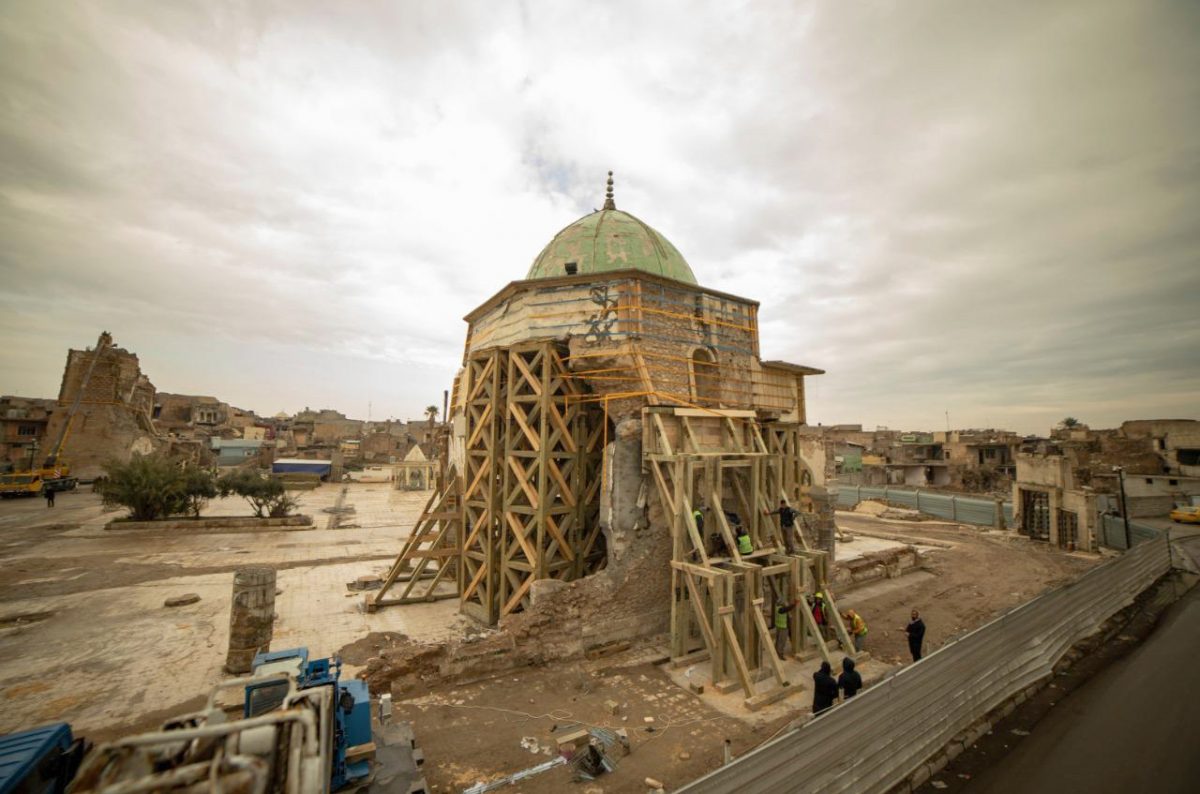
Reconstruction was announced by the United Arab Emirates on 23 April 2018, with the UAE pledging US$50.4 million toward what would become the largest single restoration project of the Revive the Spirit of Mosul initiative. The first phase, from 2018 to early 2022, was preparatory: in-depth structural, geological, and archaeological surveys; the careful removal of approximately 21,000 cubic metres of rubble (of which approximately 6,000 cubic metres of brick fragments were retained for reuse); a survey of Moslawi public opinion conducted by UNESCO and the University of Mosul in which 94% of respondents asked that the minaret be restored exactly as it was before its destruction; and the international design competition for the mosque-complex reconstruction won by an Egyptian-Iraqi team in 2021.
Active reconstruction of the minaret began in February 2022. The decision was made to rebuild it entirely in brick masonry — a technique that had not been used at this scale for centuries — with its historic leaning posture preserved. The lead reconstruction designer Maria Rita Acetoso has described the engineering challenge: rebuilding a 40-metre rounded brick shaft with a 1.6-metre horizontal lean, an internal double-helical staircase, and seven bands of carved decorative brick, on the historic base, which had itself been weakened both by centuries of subsidence and by the 2017 explosion. The approved lean was achieved through specialised positioning of the brick rows, with local engineering improvements to reinforce the joints. Historical fragments salvaged from the rubble were reused wherever possible, including the external decorative brick panels. The minaret was capped with an Iraqi flag at approximately 10:30 am on 13 November 2024 — the symbolic end of the reconstruction.
The wider mosque complex was rebuilt to its pre-2014 plan, with traditional techniques and significant adaptive improvements (modern fire-safety, climate-control, and accessibility infrastructure). The mosque reopened for prayer in late 2024; its formal inauguration took place on 1 September 2025, in a ceremony attended by Iraqi Prime Minister Mohammed Shia al-Sudani, UNESCO's deputy director-general Qu Xing (representing director-general Audrey Azoulay), UAE Minister of Culture Sheikh Salem bin Khalid al-Qassimi and former minister Noura Al Kaabi, and the European Union delegation led by the Commission's Director for the Middle East. The minaret has resumed its historic role as the principal vertical emblem of the Mosul skyline.
iii. The Al-Saa'a Convent & the Al-Tahera Church
Mosul's principal Christian heritage monuments, both in the Old City and both restored in parallel with the Al-Nūrī Mosque, are the Dominican Convent of Our Lady of the Hour (Al-Saa'a, "the clock") and the Syriac Catholic Church of the Immaculate Conception (Al-Tahera).
The Al-Saa'a Convent was founded in 1870 by the first pontifical Dominican mission to Mesopotamia, with construction of the conventual church between 1862 and 1873. From its founding the convent had a triple character: religious, with the church and seminary; cultural and educational, with schools for boys and girls (including, after 1881, the first teacher-training college for women in Iraq), and a printing press — the first in Mesopotamia — that produced the first Arabic-language Bible, the first Kurdish grammar, and a substantial output of theological and scholarly works; and humanitarian, with a hospital and a mission for the poor. In 1880, Empress Eugénie de Montijo of France (the wife of Napoleon III) donated the famous clock tower in recognition of the Dominicans' service to Mosulis during a typhoid epidemic in the 1870s; the four-faced clock, installed in 1881, tolled every hour and gave its name — al-sāʿa, "the clock" — to the surrounding neighbourhood. The convent's church building consists of two equal-sized wings, each with a large dome, around a central courtyard.
During the 2014–2017 occupation, the Al-Saa'a complex was looted and ransacked: the church was damaged by shellfire and explosives, the library and printing-press archives were destroyed, the convent's residence and outbuildings were vandalised. UNESCO began stabilisation of the church in 2020 with the Dominican Order's official approval; rehabilitation accelerated from 2021. The interior of the church was finalised, and the House of Prayer — a neighbouring building — was rehabilitated as a multipurpose educational and cultural centre with funding from ALIPH; work on this centre was completed in February 2024. The convent's principal restoration was completed in early 2024 and formally inaugurated, with the Al-Nūrī Mosque and Al-Tahera Church, on 1 September 2025.
The Al-Tahera Church, the Syriac Catholic Church of the Immaculate Conception, opened in its present form in 1862 in the heart of the Old City. The church incorporates earlier elements going back to the 800-year-old historic Syriac presence in Mosul; it has been a principal place of worship for the Syriac Catholic community continuously through the modern period, with brief interruptions in the most acute phases of communal crisis. During the 2014–2017 occupation, Al-Tahera was severely damaged: walls demolished, the roof collapsed, the interior gutted. UNESCO began the restoration in 2020 under the UAE-financed component of Revive the Spirit of Mosul. The work used traditional techniques, with extensive participation of Mosuli Syriac Catholic craftspeople in the restoration of plaster work, the reconstruction of the wooden iconostasis, and the recovery of liturgical objects. Al-Tahera was handed back to the Syriac Catholic community in September 2024, with the bells — recast from materials including pieces of the original bells — rung for the first time since 2014. The formal inauguration coincided with that of the mosque and convent on 1 September 2025.
iv. The Mosul Museum
The Mosul Cultural Museum (Matḥaf Ḥaḍārat al-Mawṣil) is the second-largest museum in Iraq after the National Museum of Iraq in Baghdad. It was founded in 1952 in the adjacent royal reception hall, and moved into its present larger modernist building — constructed in 1974 in the museum's adjacent garden — with substantially expanded gallery and storage facilities. The museum's collections were organised around four themes: a prehistoric gallery; an Assyrian gallery, with monumental sculpture from the excavations at Nineveh, Nimrud and Khorsabad; a Hatrene gallery, with material from the Parthian-period caravan city in the southern desert of Nineveh; and an Islamic gallery, with material from the medieval and early-modern Islamic periods.
The most monumental pieces in the collection — those that could not be safely evacuated in 2003 — included the colossal Lion of Nimrud (one of a pair of stone guardian figures from the Goddess Ishtar Sharrat-Niphi Temple, reign of Ashurnasirpal II, 9th century BCE); a pair of monumental lamassu (winged human-headed bulls from Nineveh or Nimrud, Assyrian guardian figures of palace gates); the Banquet Stela of Ashurnasirpal II (a four-tonne stone slab recording the king's celebration of the inauguration of his new palace at Nimrud); the throne base of Ashurnasirpal II; and a precious early Islamic wooden cenotaph.
On 26 February 2015, Daesh fighters released a video of themselves destroying multiple of the museum's monumental Assyrian sculptures with sledgehammers and pneumatic drills. The Lion of Nimrud, both lamassu, the throne base, and other major pieces were either reduced to fragments or smashed entirely. The Banquet Stela was heavily damaged. Around 28,000 rare books and manuscripts in the museum's library were burned. An unknown but substantial number of smaller objects was looted and dispersed onto international antiquities markets; some have been recovered since 2017, others not. The museum building itself was damaged during the 2017 battle — its roof was mined with explosive devices that were defused after liberation — and Daesh had also used the building for some operational purposes.
Rehabilitation has been undertaken since 2018 through a unique five-partner consortium: the Iraqi State Board of Antiquities and Heritage (SBAH); the Mosul Cultural Museum itself, with its returning staff; the Musée du Louvre (Paris), leading on collections and exhibition design; the Smithsonian Institution (Washington), leading on building stabilisation and staff training; and the World Monuments Fund, joined in 2020, leading on architectural rehabilitation. Funding has been provided principally by the International Alliance for the Protection of Heritage in Conflict Areas (ALIPH), founded in 2017 at French and Emirati initiative, which made the Mosul Museum its founding project with an initial grant of US$1.3 million expanding to US$15.8 million committed in total.
The work has proceeded in carefully sequenced phases. The first phase, 2018–2020, stabilised the building: fortifying doors, replacing windows, reinforcing exterior fences, removing explosive devices that had been mined in the roof, sorting and storing thousands of fragments from the destroyed monumental sculptures. A comprehensive damage assessment, coordinated by the Louvre and published in November 2019, established the technical road map. The second phase, from 2020, undertook the architectural rehabilitation of the building and the painstaking conservation of fragments. Museum staff, in collaboration with Louvre experts, have been documenting, cleaning, and reassembling the lamassu, the Lion of Nimrud, the Banquet Stela, and other monumental works from fragments ranging in size from pebbles to multi-tonne boulders — what curators describe as the world's largest three-dimensional jigsaw puzzle. The museum is on schedule for a 2026 reopening. New exhibition design, public-presentation strategies, and interpretive materials are being developed in collaboration with the Louvre; staff training is being provided by the Smithsonian under a Phase Two skills-training programme.
v. Heritage houses of the Old City
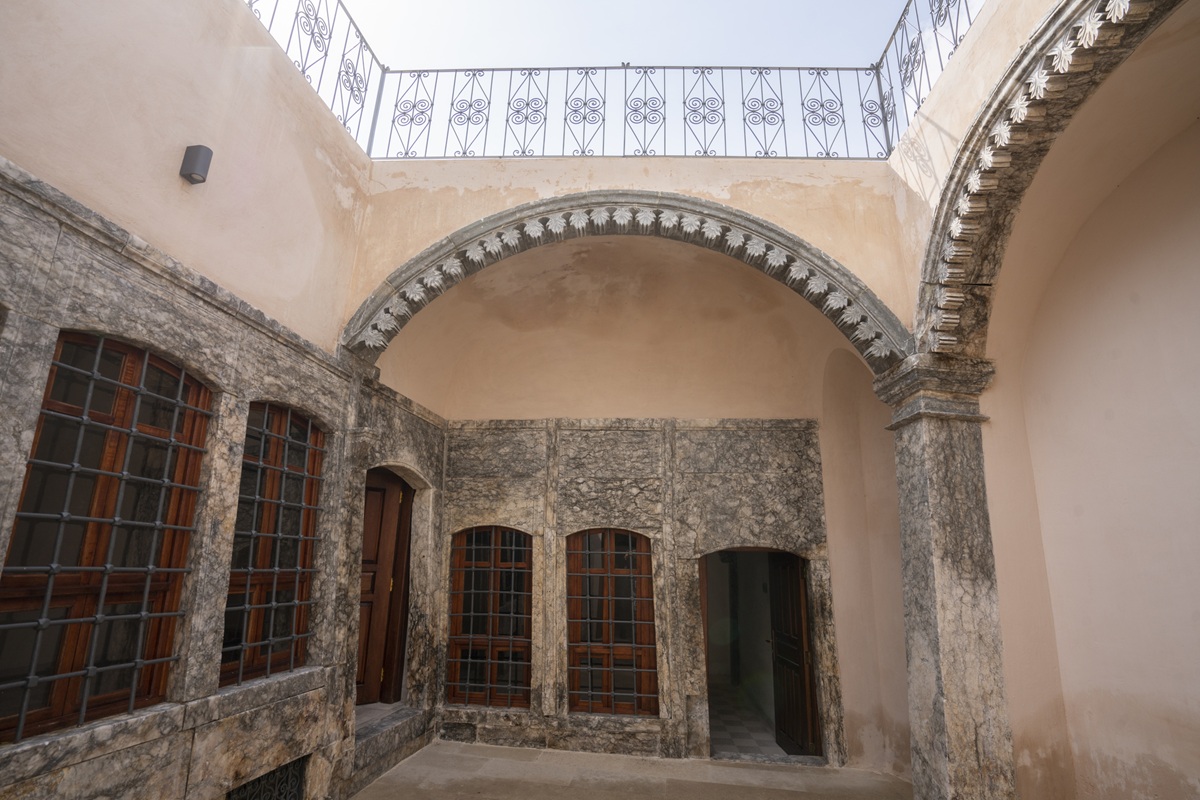
Beyond the major religious and museum monuments, the architectural heritage of Mosul rested on a distinctive vernacular: the bayt mawṣilī, the traditional Mosuli courtyard house, built of locally-quarried Mosul marble (a fossiliferous limestone, the principal building stone of the city), with characteristic features — a sunken central courtyard with a fountain or pool, elaborately carved īwān alcoves opening from the courtyard onto the ground floor, alabaster panels in the principal reception rooms, latticed wooden mashrabiyya screens at upper-floor windows, painted plaster ceilings with calligraphic and floral motifs, deep cisterns for water storage. Many of these houses had been continuously occupied for two to three centuries.
The Old City as a whole — the densely-built historic core on the right bank of the Tigris between the Bāb al-Jadīd and Bāb al-Sarāy — was the part of Mosul most heavily damaged during the 2017 battle; UNESCO estimates that approximately 80% of the Old City was destroyed. The heritage houses suffered disproportionately: their pre-modern construction made them more vulnerable to blast damage than later concrete structures, and their narrow streets prevented heavy-equipment access for both the fighting and for early relief operations.
UNESCO's heritage-house programme, undertaken with EU and other donor funding, has rehabilitated 124 historical houses using traditional techniques and materials as of February 2024. The selection of houses prioritised structures of particular architectural significance, those identified by their owners as houses they wished to return to, and houses in clusters that could anchor neighbourhood-level urban recovery. Each house has been documented before, during, and after rehabilitation. The programme has had a parallel workforce-development objective: by mid-2023, approximately 1,300 Iraqi heritage workers had been trained in traditional stonemasonry, alabaster restoration, lime plastering, woodwork, and the related crafts. ICCROM and the University of Mosul have been the principal training partners; many of the trained workers are women and many are recent graduates of the University of Mosul's Architecture programme.
The 124-house total is, however, only a fraction of the housing stock that requires attention. The Old City still contains hundreds of historic houses in advanced states of disrepair, and there are persistent debates within the Mosul heritage community about whether to prioritise comprehensive rehabilitation of a smaller number of buildings or lighter-touch stabilisation of more. The longer-term programme will be determined in significant measure by the level of federal and external funding that follows the formal end of the Revive the Spirit of Mosul programme cycle.
vi. Other religious heritage
Beyond the Al-Nūrī Mosque and the two principal churches, Mosul's religious heritage included a network of historic mosques, shrines, churches, and tombs of profound cultural significance. Many were damaged or destroyed during the occupation:
The Tomb of the Prophet Yūnus (Jonah), on the east-bank mound that bears his name — long venerated by Muslims, Christians and Jews as the burial place of the biblical/Quranic prophet — was destroyed by Daesh on 24 July 2014. Subsequent excavation work at the site uncovered substantial remains of the underlying 8th-century BCE Assyrian palace, which had been long suspected but never excavated; this has been an unintended archaeological outcome of the destruction. Reconstruction of the Yūnus mosque itself has been undertaken in stages under the Iraqi Ministry of Endowments.
The Aghawat Mosque, a small but historically significant Sunni mosque in the Old City, has been rehabilitated by UNESCO as part of the Revive the Spirit of Mosul initiative. Similar small-scale mosque restorations have been undertaken across the Old City. The shrine of Imām ʿAwn al-Dīn, a 13th-century Sunni shrine famous for its blue-glazed tile work, was destroyed by Daesh and is undergoing reconstruction. Numerous other smaller shrines, tombs, and place of pilgrimage were destroyed or damaged.
The Christian heritage beyond Al-Saa'a and Al-Tahera includes the Mar Tūma (St Thomas) Church, the Mar Buthyūn Chaldean Cathedral, the Mar Ḥudani Church, the Syriac Orthodox Mar Tahmazgerd Church, and many smaller chapels and convents. Reconstruction has proceeded unevenly — some have been rehabilitated by individual diocesan and conventual authorities working with international partners, others remain on waiting lists. The Christian community of Mosul, which numbered approximately 50,000 in the early 2000s, fell to a few thousand during the occupation; partial return after 2017 has brought the figure to around 10,000–15,000, with the majority of the diaspora resettled elsewhere in Iraq or abroad.
The Yazidi religious heritage in the Sinjar district was particularly heavily affected. The principal Yazidi temple complex at Lalish (in the Sheikhan district, Nineveh, but administered in cooperation with the Kurdistan Regional Government) was not occupied by Daesh, and remains the most important Yazidi pilgrimage site. The Yazidi shrines on Sinjar Mountain and at the foothill villages were heavily damaged or destroyed; reconstruction has been undertaken in partnership with the Yazda foundation and the international Yazidi diaspora.
vii. The ancient Assyrian sites: Nineveh, Nimrud, Khorsabad
The Governorate takes its name from Nineveh (Ninwa), the ancient Assyrian capital whose mounds — Tell Kuyunjik and Tell Nabi Yūnus — sit on the east bank of the Tigris within the modern city of Mosul. Nineveh was the largest city in the world at its 7th-century BCE height under Sennacherib (704–681 BCE) and his successors, with monumental palaces (the South-West Palace of Sennacherib and the North Palace of Ashurbanipal), city walls 12 kilometres in circumference with eighteen gates, the library of Ashurbanipal (which preserved cuneiform versions of the Epic of Gilgamesh and the Babylonian creation epic), and the elaborate water-management systems that supplied the city from the Khinis aqueduct system 60 kilometres to the north. The city was sacked by a Median-Babylonian coalition in 612 BCE and never fully recovered as a major urban centre; the mounds have been continuously archaeologically investigated since the British excavations of the 1840s. (Nineveh's role in the city's history is treated in detail in our History entry.)
The Daesh occupation extended to the archaeological sites. At Nineveh, the gates of the ancient walls — the Mashki Gate, the Adad Gate, the Nirgal Gate — were bulldozed or dynamited; reliefs in the South-West Palace, exposed by the 19th-century excavations and protected by modern shelters since the 1970s, were damaged. Excavations at Tell Nabi Yūnus, undertaken after the Yūnus mosque destruction, have uncovered substantial palace remains; rebuilding the gates has been undertaken by an Iraqi-international team led by the University of Pennsylvania Museum and the Iraqi SBAH, with the Mashki Gate reconstruction completed in 2022.
Nimrud (Kalḫu), the Assyrian capital under Ashurnasirpal II (883–859 BCE) approximately 30 kilometres south of Mosul, was the site at which the Lion of Nimrud, the Banquet Stela, and many of the Mosul Museum's monumental works originated. Daesh used heavy machinery to demolish the surviving palace structures at Nimrud in March 2015. The site has been progressively restored since 2018 by an Iraqi SBAH team in partnership with the World Monuments Fund and the Smithsonian; the Northwest Palace structure has been partially rebuilt.
Khorsabad (Dūr-Sharrukīn), the brief capital of Sargon II (722–705 BCE) approximately 15 kilometres northeast of Mosul, was less heavily damaged than the other sites but its excavated guardian sculptures and reliefs were affected. The site has been progressively re-stabilised since 2018.
Other ancient sites in the Governorate — Hatra, the Parthian-period caravan city in the southern desert which is a UNESCO World Heritage Site, although currently on the World Heritage in Danger list since 2015; Tell Halaf, the type-site of the eponymous Neolithic culture; and the Old Christian monasteries of the Nineveh Plain such as Mar Behnam, Mar Mattai, and Rabban Hormizd — each carry their own restoration histories, with varying degrees of completion as of 2026.
viii. The work that remains
The headline achievements of Mosul's heritage reconstruction since 2017 are substantial. Three of the city's four most-recognised heritage monuments — the Al-Nūrī Mosque and Al-Hadbāʾ minaret, the Al-Saa'a Convent, and the Al-Tahera Church — have been restored, with the fourth (the Mosul Museum) on schedule for 2026 reopening. 124 heritage houses have been rehabilitated; 1,300 heritage workers have been trained; the ancient Assyrian site gates have begun to be reconstructed; many smaller shrines and churches have been restored.
The work that remains is, however, much larger. Of the approximately 50 documented heritage monuments destroyed or damaged in the city, fewer than half have been formally restored; the rest await funding. The Old City contains, by various estimates, between 400 and 800 surviving historic houses; 124 have been rehabilitated. Numerous shrines, smaller churches, and cemeteries are awaiting attention. The Yazidi religious heritage in Sinjar requires sustained reconstruction effort across at least the next decade. Many of the ancient Assyrian palace sites at Nineveh and Nimrud remain only partially restored. The capacity of the SBAH to maintain restored monuments over the long term — against the headwinds of climate stress, urban pressure, and budget constraints — will require sustained federal investment and continued international partnership.
Equally significant is the question of what reconstruction is for. The residents of Mosul, as articulated in the public response to the 1 September 2025 inauguration ceremonies, have repeatedly underlined a position that is, in some respects, in tension with the international-led model of the reconstruction so far: that the sacred duty of rebuilding the city's heritage should belong, in the long run, to the Iraqi state and the Mosuli people themselves, with international support as supplement rather than as principal. This is a question for the post-Revive the Spirit of Mosul period, in which the institutional capacity built during the international programme will need to migrate, in measured stages, into Iraqi public institutions: the SBAH, the Mosul Directorate of Antiquities, the relevant religious authorities, the University of Mosul and Northern Technical University training programmes, and the Mosul Cultural Museum itself.
What has been demonstrated by the work between 2018 and 2026 is that this migration is possible. The reconstruction of the Al-Hadbāʾ minaret — led technically by international experts but executed on the ground by Mosuli stonemasons and brickmakers, with the trained local heritage workforce that will be available for the next phase of work — is the proof case. The Mosul Museum reopening in 2026 will, if the schedule holds, be the second. The question, as the 850-year minaret again leans over the Old City as it has for centuries, is whether the next 850 years will see the city's heritage extended rather than merely preserved.
References
- UNESCO (2018–2025). Revive the Spirit of Mosul — programme reports, monument-by-monument documentation.
- UNESCO (2025). "Al-Hadba minaret" — restoration documentation.
- UNESCO (2025). "Al-Saa'a Convent" — restoration documentation.
- UNESCO (2025). "A milestone for Mosul: Iraq inaugurates iconic landmarks rehabilitated by UNESCO."
- Wikipedia (2025). "Great Mosque of al-Nuri, Mosul."
- PBS News (2025). "Iraq reopens historic al-Nuri mosque in Mosul 8 years after Islamic State destruction."
- The National (2025). "Unesco deputy chief hails reopening of Mosul's Al Nuri Mosque after painstaking rebuild."
- Euronews Culture (2025). "War-ravaged landmarks in Iraq's Mosul are reopening after UNESCO-led restoration project."
- Kurdistan24 (2025). "Mosul's Historic Al-Nuri Mosque Reopens."
- FSSPX News (2025). "Iraq: Official Reopening of Two Christian Churches in Mosul."
- Smithsonian Institution / Cultural Rescue Initiative (2023, 2024). "The Rehabilitation of the Mosul Cultural Museum" reports.
- Smithsonian Magazine (2023). "Mosul Cultural Museum to Reopen in 2026."
- Musée du Louvre Press (2021). "Six years after Daesh attack, the Mosul Cultural Museum is being rehabilitated."
- ALIPH Foundation (2024). "Rehabilitation of the Mosul Museum" — project documentation.
- ICCROM and University of Mosul (2023). Heritage workforce training programme reports.
- Iraqi State Board of Antiquities and Heritage (SBAH) (2024). Annual heritage protection and reconstruction reports.
- UAE Ministry of Culture and Knowledge Development (2018, 2019). Project documentation on the Al-Nūrī Mosque, Al-Saa'a, and Al-Tahera reconstruction commitments.
- World Monuments Fund (2024). Mosul Cultural Museum and Nimrud project reports.
- Ibn al-Athīr (12th–13th c.). al-Kāmil fī al-Tārīkh — on Nūr al-Dīn's construction of the Al-Nūrī Mosque.
- University of Pennsylvania Museum / Iraqi SBAH (2022). Mashki Gate reconstruction documentation.