The Culture of Nineveh.
A dialect of Arabic with a distinctly soft inflection; a musical tradition tracing to the eighth century; a school of miniature painting that flourished under the Atabeg; a cuisine whose flagship dish bears the city's name and the silhouette of its domes; a literary café where, six months after liberation, men and women sat together again debating Mahmoud Darwish and Naguib Mahfouz. The culture of Nineveh, taken on its own terms.
To describe the culture of any city is to describe a long argument it has been conducting with itself about who it is. In Nineveh, that argument runs through more than four millennia of continuous settlement, through a position at the junction of Arab, Kurdish, Turkmen, Assyrian, Yazidi and Persian cultural worlds, and through a recent rupture of three years' enforced silence followed by a slow, deliberate recovery of voice. What follows is not an inventory — no inventory could be complete — but a tour of the principal forms in which the culture of Nineveh has expressed and continues to express itself: language, literature, music, painting, food, cinema, the institutions in which all of these gather, and the post-2017 revival that has reanimated them.
i. Language & the Moslawi dialect
The dominant language of Nineveh is Arabic, in the local Moslawi (Mawṣilī) variety — one of the most distinctive subdialects of Iraqi Arabic. Moslawi is classified by linguists as a qǝltu dialect: a member of the northern Mesopotamian Arabic group spoken historically by the urban populations of Mosul, Tikrit, the Christian and Jewish communities of Baghdad, and most Iraqi Jewish and Christian communities into the twentieth century. The qǝltu group is named for its distinctive preservation of the classical Arabic form qultu ("I said") with a vocalised final, distinguishing it from the gilit dialects of southern and central Iraqi Bedouin and rural populations, where the same form is pronounced gilit. The dialect is markedly close to the Levantine Arabic of northern Syria and to Anatolian Arabic, and historically formed a continuum with both before twentieth-century borders interrupted that continuum.
Moslawi is recognisable to other Arabic-speakers by several features: a soft, sibilant pronunciation of the r approaching a French r grasséyé; the preservation of the interdental fricatives th (ث) and dh (ذ); the use of distinctive vocabulary items, often of Aramaic, Turkish, or Persian origin, reflecting Mosul's long history as a meeting-point of these linguistic worlds; and a melodic intonation that local speakers consciously associate with the city's character. The dialect is in everyday use in Mosul and across most of Nineveh's nine districts; it coexists with other varieties of Iraqi Arabic among returnees from Baghdad and southern provinces, and with the languages of the Governorate's other communities.
Those other languages are themselves substantial. Kurdish, in its Sorani variety, is the principal language of Akre, northern Sheikhan, and parts of Sinjar and Tilkaif. Turkmen (a southern variant of Oghuz Turkic) is the dominant language of Tal Afar and parts of the western Jazira. Aramaic survives in two principal communities: Modern Eastern Aramaic (Sureth) among the Assyrian, Chaldean, and Syriac Christian communities of the Nineveh Plain; and Mandaic among the small Mandaean community. Kurmanji Kurdish is the everyday spoken language of much of the Yazidi community in Sinjar, although Yazidi religious texts and ritual language draw on a more conservative variety. The Shabak community uses its own variety, Shabaki, classified by some linguists as a dialect of Gurani and by others as a distinct language with substantial Kurdish and Persian admixture. The literary and educational language of all communities is, however, Modern Standard Arabic.
ii. The literary tradition
Mosul's literary tradition runs at least to the second Islamic century. The figure most associated with the city's pre-modern Arabic literature is Iṣḥāq al-Mawṣilī (767–850 CE), the Persian-origin Abbasid-era musician, scholar, and poet whose family had been resident in Mosul, and whose biographies in the Kitāb al-Aghānī made him one of the most-quoted figures in classical Arabic literature on courtly music and poetry. The medieval city produced or hosted a long succession of historians, jurists, geographers, and poets: ʿIzz al-Dīn Ibn al-Athīr (1160–1233), historian of the Crusades and author of the universal chronicle al-Kāmil fī al-Tārīkh; his brothers Majd al-Dīn (a jurist and lexicographer) and Ḍiyāʾ al-Dīn (a literary theorist); and many others. The Atabeg court of Mosul under Badr al-Dīn Lūʾluʾ (1218–1259) was a centre of scholarship and patronage of the arts comparable in some respects to Aleppo and Damascus in the same period.
The Ottoman centuries saw the Mosuli historiographical tradition deepen. The eighteenth- and early-nineteenth-century historians of the Jalīlī period — among them Yāsīn al-ʿUmarī and several others — produced detailed local histories of Mosul under its semi-autonomous local dynasty (1726–1834), in works that have been used by modern scholars including Percy Kemp in his Oxford doctoral thesis on the Jalīlī era as the principal Arabic-language source on the period. The Mosuli literary world of the Ottoman centuries was substantial, with substantial trade in manuscripts and a network of madrasahs, libraries and copyists.
The twentieth century produced a generation of Mosuli poets and novelists whose work circulated nationally and across the Arab world. Mosul's role in the modern Iraqi novel and in Iraqi poetry has been documented in monographs and edited collections; the city's modernist literary scene of the 1950s–1970s had its own coffee-houses, publishing houses, and literary magazines. Names associated with this generation and its successors include Abdul Munim al-Amir (poet and novelist, director of the Mosul Writers' Union), and many others.
The Daesh occupation of 2014–2017 fell on this tradition with particular brutality. Writers were imprisoned and executed; publishers and bookshops closed; the public reading of secular literature was prohibited. Many Mosuli writers continued to write in secret. Al-Amir, the director of the Writers' Union, wrote his novel Faraba — inspired by the ninth-century philosopher al-Fārābī — under the occupation; it was published after liberation. Other writers worked on poetry, short fiction, and memoir that surfaced only after the city was retaken.
iii. The Book Forum & the literary café
The most visible site of Mosul's post-2017 literary revival has been the Book Forum (Muntada al-Kitāb), a café in the university district founded by Fahad Sabah and Harith Yassin in late 2017. The café opened only months after the formal liberation of Mosul in July of that year, in a space whose walls are lined with portraits of medieval Iraqi poets — al-Mutanabbī foremost — alongside Mahmoud Darwish, Naguib Mahfouz, Kafka, Dostoyevsky, and photographs of Mosul in the 1930s. The space hosts poetry readings, book launches, literary debates, and the kind of mixed-gender intellectual conversation that, under the occupying authority, would have been punishable by flogging or death.
Comparisons with Baghdad's Shabandar Café, the literary heart of the capital before its 2007 bombing, have come naturally. The Book Forum has, in the years since its opening, become the spiritual centre of a small but persistent Mosul literary revival. Second-hand book stalls have reopened next to the bombed-out concrete carcasses of buildings on the right bank; the writers' union has resumed its functions; younger poets have published their first collections. International journalists who have visited the city in the post-2017 period have repeatedly identified the Book Forum as the most consistent visible sign of cultural recovery.
iv. Music: the Mosuli maqam tradition
The musical heritage of Mosul is anchored in the maqam tradition — the system of melodic modes that underlies the art music of the Arab world, Persia, Turkey, and Central Asia. The Mosuli branch of this tradition is one of the oldest urban schools of Arabic maqam in the world; some scholarship traces its formation in the city to the eighth century CE, contemporary with the early Abbasid musical court of Isḥāq al-Mawṣilī himself. The Mosuli maqam school is distinct in its repertoire, in its modal preferences, in its characteristic vocal ornaments, and in its long use in both religious and secular contexts — in Muslim devotional recitation, in Christian liturgy, and in secular gatherings.
Like all maqam traditions, the Mosuli school operates on a set of modal frameworks rather than fixed compositions. A maqam (literally "place" or "position") specifies a scale, a set of melodic tendencies, a hierarchy of tones, and an associated emotional register: Rast for pride and dignity, Bayāt for tenderness, Ḥijāz for desert solitude and mysticism, Ṣabā for sorrow, Sīkā for ancient and religious memory, and so on across the dozens of maqamat recognised in the tradition. Each piece, whether sung or instrumental, is built within a maqam as both compositional template and improvisational ground.
The most venerated figure of the Mosuli school in living memory is Malla ʿUthmān al-Mawṣilī (1854–1923) — muezzin, hafiz, composer, and one of the most influential figures in the music of the late Ottoman Arab world. Malla ʿUthmān's reputation extended well beyond Mosul: his compositions and his teaching influenced the next generation of Egyptian composers, including Sayyid Darwīsh, and his maqam settings of Qurʾanic recitation remain a model for Iraqi religious cantillation. He requested in his last will to be buried with the recitation of a specific maqam, Ya Ilāhī qad rajā minka al-hudā, asking for the mercy of God.
The Mosul Maqam tradition encompassed a network of performance venues, master-pupil chains, and an active circulation of recordings on vinyl, cassette, and reel-to-reel tape that persisted into the twenty-first century. The Spring Theatre and the Maqam House in Mosul were active venues into 2014. Al-Rabīʿ's Recording Shop — one of the oldest recording stores in the city — functioned as both a commercial outlet and a community archive of Mosuli musical heritage. The 2014–2017 occupation closed all of these. The Spring Theatre was repurposed as a prison and execution site; the Maqam House was left in ruins; musicians were imprisoned or killed; instruments were burned. Performers buried their ouds in their gardens. Those who continued to play did so silently, in private rooms, with their nails clipped short to muffle the strings.
The post-2017 revival has been gradual but persistent. Al-Rabīʿ's Recording Shop reopened after the war; the Mosul Maqam Archive project (a collaboration between the University of Exeter, Mosul-based researchers, and the AUIS-based Kashkul Center, funded by the British Council's Cultural Protection Fund) has digitised rare recordings of the Mosuli repertoire and recorded oral histories with surviving masters. Eleven in-person classes at the University of Mosul Faculty of Fine Arts, covering more than fifteen maqamat, have introduced 40 to 50 new students — including singers, beginners, and child learners as young as nine — to the tradition under the guidance of maqam masters Rāmiz al-Rāwī and Fakhrī Fāḍil. The Mosul Traditional Music Festival, the first of its kind since liberation, took place in March 2022 under UNESCO's Listening to Iraq programme implemented by the NGO Action for Hope; a successor festival in September 2024, held in Mosul Forest overlooking the Tigris, drew Iraqi musicians from across genres — including jazz musician and maqam scholar Amir El-Saffar — in collaboration with younger Moslawi artists.
v. The Mosul School of Painting
Beyond the contemporary music revival, Mosul has its own distinct school in the history of Islamic art. The Mosul School of Painting was a late-twelfth- to mid-thirteenth-century tradition of miniature illustration that developed in the Atabeg-period city, particularly under the patronage of the Zangid and Atabeg rulers and their successors. Mosul miniaturists illustrated scientific manuscripts — medical, botanical, astronomical — and works of poetry and history, with a characteristic palette of saturated reds, lapis blues, ochre yellows, and gold leaf. The school is distinguished from its contemporary Seljuk and Baghdad schools by a heightened sense of figural realism, a more developed treatment of clothing folds and architectural detail, and a tendency to populate its scenes with everyday figures — cooks, doctors, court attendants — rather than only the rulers being portrayed.
The most-cited surviving manuscript of the Mosul School is a twelfth-century medical illustration (now in Paris) showing four figures gathered around a seated physician; another mid-thirteenth-century piece illustrates the preparation of a ruler's meal in fine detail. The school produced its work principally for book illustration; loose-leaf paintings of the kind that survive in larger numbers from later Persian and Mughal traditions are rarer for Mosul. The Mongol invasion of 1258 (which reached Mosul in 1262) effectively ended the school as a continuous tradition, although its influence was substantial on the subsequent painting of the Ilkhanid and early Persian schools. Within the broader history of Islamic art, the Mosul School represents the high water mark of a recognisably Arab school of book illustration before the centre of gravity of the tradition shifted east to the Persian-speaking world.
vi. Cuisine
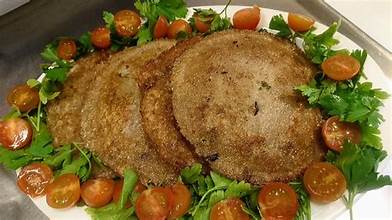
Mosuli cuisine is the most distinct regional cuisine within Iraq, and one of the most distinctive of the Mashriq. The flagship dish — the one that bears the city's name and recurs as a shorthand for Mosuli identity in diaspora communities from Erbil to Detroit — is Kubba Mawṣiliyya (Kubba Mosul). It consists of a flattened disc of finely-ground bulgur and semolina dough, encasing a heavily-spiced minced-meat filling (lamb or beef), traditionally finished with toasted pine nuts, slivered almonds, and raisins; it is shaped into a flat round disc said to evoke the domes of Mosul's mosques. The kubba is cut into wedges and served hot, accompanied by salad, yoghurt, and pickled vegetables. The dish's roots are pre-modern, identified by some food historians with the broader Mesopotamian tradition of stuffed-meat preparations going back to the ancient Akkadian and Babylonian cookery whose fragments survive on cuneiform tablets.
Beyond Kubba Mosul, the Mosuli table has its own substantial repertoire. Dolma (dūlma) in the Mosuli style consists of grape leaves, hollowed-out onions, aubergines, tomatoes, and courgettes stuffed with spiced rice and minced meat, cooked together in a single pot with pomegranate molasses and inverted onto a serving platter; the dish is the centrepiece of family gatherings and feast days. Masgūf in a distinctive sumac-spiced Mosuli preparation, Lahm bi-ʿAjīn (a thin meat-topped flatbread of which the Mosuli version is a regional reference), Burāq, Pacha (the boiled-sheep-feet stew traditional across Iraq), and many others figure on the menu of any Mosuli home. The Mosuli kunāfa, with its fine pastry strands and white cheese filling soaked in sugar syrup, is a regional speciality served at celebrations.
Mosul's coffee tradition is itself distinctive. The Iraqi coffee served in Mosuli homes and coffee-houses is dark and unsweetened, prepared in a long-handled dalla pot; the beans are traditionally ground, heated, and cooled multiple times before serving to remove what local tradition calls the "harshness" of the imported beans. Raisin juice and mann al-samāʾ (an Iraqi taffy with walnuts or pistachios, the "manna from heaven" of the Iraqi confectionary tradition) are sold from market stalls.
The Daesh occupation hit the food world of Mosul on multiple axes. Many of the historic restaurants of the city closed; markets were disrupted; the Christian and Yazidi communities whose distinctive contributions to the regional cuisine had long enriched the Mosuli table were expelled. The post-2017 revival has seen the reopening of some of the most celebrated kitchens, including the Ḥadbāʾ Kibbeh restaurant near the Al-Nūrī Mosque (a small kubba-only operation on a newly-reconstructed street, with customers carrying their plates to the teahouse next door), the Abū Janā Seafood Restaurant (renowned for its Mosuli-style masgūf), and the resumption of weekly markets at the Bāb al-Sarāy and Nabī Yūnus bazaars.
vii. Cinema, theatre & festivals
Mosul's cinema and theatre tradition is younger and smaller than the literary and musical traditions; the city did not host its own substantial commercial cinema industry on the scale of Cairo or Beirut, although Iraqi cinema as a national tradition has had Mosuli contributors and Mosul-set works. The local theatre tradition centred on the Spring Theatre on the right bank, the principal venue for Mosuli drama through the 1990s and 2000s. The University of Mosul's Faculty of Fine Arts has been a continuing source of theatre and visual-arts training. The Daesh occupation closed all of this; the Spring Theatre was, as noted above, used as a prison and execution site.
The most visible institutional initiative for cinematic recovery has been the FilmLab at the Institute of Fine Arts of Mosul, established by UNESCO with European Union support and in partnership with the City Theatre of Ghent. The FilmLab, opened in 2021, trained twenty Mosuli students across the range of film-production roles — directing, screenwriting, editing, acting, set and costume design, audio and lighting — while producing nine short films. A creative space called The Station, opened at a former railway station in June 2021, has functioned as a hub for young Mosuli creatives in the cultural and creative industries: concerts, workshops, exhibitions, and rehearsals occupy its rooms most days of the week.
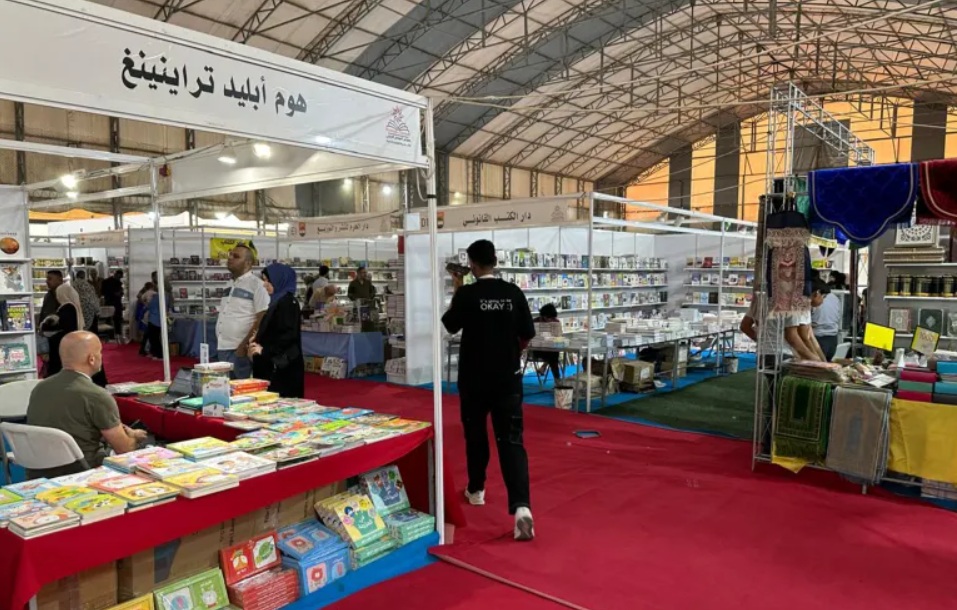
Beyond the FilmLab and the Station, post-2017 cultural festivals have proliferated. The Mosul Traditional Music Festival (March 2022, September 2024, and subsequent editions) has been described above. The Mosul International Book Fair, post-pandemic, has resumed. Open-air screenings, literary readings, oud concerts at the Book Forum, women artists' exhibitions, and similar events have multiplied. None of these recovery activities individually has the scale of Mosul's pre-2014 cultural life; collectively, however, they constitute a continuous proof that the cultural life of the city is reassembling itself.
viii. Coffeehouses, libraries & cultural institutions
The institutions in which culture gathers and reproduces itself are no less important than the cultural products themselves. In Mosul, those institutions have historically included — in addition to the universities and the great mosques and churches treated in our Education, Religions and Heritage entries — a particular network of coffeehouses, the city's libraries, the museums, and the cultural and literary unions.
The traditional coffeehouse (maqhā) of Mosul is a more politically and intellectually charged institution than its tourist-facing equivalents elsewhere. Coffeehouses near the universities have served as informal seminar rooms for generations of Mosuli intellectuals; coffeehouses near the markets and the great mosques have served as community-news centres and dispute-resolution forums. The Book Forum, opened in 2017, is the most-documented post-occupation example, but it operates within a continuous tradition.
The libraries of Mosul have a particular history. The University of Mosul's central library was the largest in Iraq, with substantial manuscript collections and a comprehensive periodicals archive; it was burned in 2003 (the staff carried out books to protect them, returning many after the post-2003 reopening), and burned again, more catastrophically, in 2017. The Al-Wāʿiẓ Library, the Saraya Library, and several smaller specialist collections were also damaged. The post-2017 rebuilding of library collections has been one of the slower-tail elements of cultural recovery; bilateral donations of books from Iraqi and international institutions, a campaign supported by the Iraqi diaspora, and the patient resumption of acquisitions by the University of Mosul have begun to repopulate the shelves.
The Mosul Museum, the second-largest museum in Iraq after the National Museum in Baghdad, holds ancient Mesopotamian collections that draw heavily on the Assyrian excavations at Nineveh, Nimrud, and Khorsabad. The museum was severely damaged in February 2015 when Daesh fighters publicly destroyed several galleries' worth of objects on video; many objects were destroyed beyond recovery, others looted, and the museum closed for years. Reconstruction of the museum has been undertaken with support from the Smithsonian Institution and the Mosul Museum Reconstruction Project (a Louvre/World Monuments Fund initiative), with phased reopening underway. (The museum's history, contents, and the reconstruction itself are treated in greater detail in our Heritage entry.)
The Mosul Writers' Union, the Mosul Fine Arts Union, and similar professional bodies have all resumed their functions since 2017. UNESCO's wider Revive the Spirit of Mosul initiative, with US$115 million mobilised across 15 partners (the United Arab Emirates and the European Union foremost), is the most ambitious cultural-and-heritage recovery programme; it has rehabilitated 124 historical homes, renovated 404 classrooms, and supported the cultural recovery described in this entry alongside the heritage restoration described in our Heritage entry.
ix. The post-2017 cultural revival
What the events of 2014–2017 took from Mosul, materially, can be measured: the burnt manuscripts, the destroyed instruments, the looted museum cases, the books that did not return from hiding. What was taken culturally is harder to measure but no less consequential: three years in which children did not see paintings, in which musicians did not perform, in which writers had to write in secret. The post-2017 cultural revival has been, in part, the slow recovery of these material things — the restoration of the Mosul Museum, the reopening of cafes and bookshops, the digitisation of surviving maqam recordings. In larger part, however, it has been the reassembling of cultural confidence in a population that had been told for three years that its culture was haram, was illegitimate, was to be replaced. The reassembling has happened slowly and unevenly, and it is not complete; it has happened, in many cases, against the headwinds of a still-incomplete reconstruction of the city's basic infrastructure, an under-funded education system, and the continuing trauma described in our Health entry. That it has happened at all is the most consequential cultural fact of the post-2017 period.
The institutions that have led the revival are not predominantly governmental. The Book Forum is a privately-run café. The Mosul Maqam Archive is an international research collaboration. The FilmLab is UNESCO-funded but city-rooted. The cafes, restaurants, performance halls, and Sunday-morning gatherings on which everyday Mosuli cultural life now rests are the work of returning Mosulis themselves — teachers, musicians, students, cooks, photographers, oud-makers, calligraphers. Many of them are the same individuals who buried instruments in their gardens, taught Arabic poetry in basements during the occupation, or carried books out of burning libraries. The culture of Nineveh, in 2026, is no longer at the level of pre-2014; it is, however, no longer at the level of 2017 either. The continuity of three thousand years of cultural production on the same banks of the Tigris has been re-established.
References
- UNESCO (2018, 2024). Revive the Spirit of Mosul — cultural life programme reports.
- Middle East Institute (2020). "Mosul's Book Forum: Rebuilding minds one book at a time."
- Arab News (2018). "Mosul embraces book culture in post-Daesh Iraq."
- Bajalan, B. et al. (2024). Mosul Maqam Archive — Digital Archive of the Middle East, University of Exeter.
- Marcus, S. (2007). Music in Egypt: Experiencing Music, Expressing Culture. Oxford University Press.
- British Council Cultural Protection Fund / DCMS (2024). Mosul Maqam project reports.
- Kemp, P. (1979). Mosul and Mosuli Historians of the Jalīlī Era (1726–1834), doctoral thesis, University of Oxford.
- al-ʿUmarī, Y. (18th c., various manuscripts). Tārīkh al-Mawṣil and related local histories of the Jalīlī period.
- Mosul Maqam Festival (2022, 2024). Programme materials.
- News.Exeter (2024). "Mosul residents to celebrate the city's ancient musical heritage and its resilience at new festival."
- Action for Hope NGO (2019–2024). Wassla and Listening to Iraq project documentation.
- UNESCO Heritage Emergency Fund (2019–2020). Project documentation.
- Wikipedia (2025). "Mosul School of Painting" and "Mosul."
- Mosul Museum Reconstruction Project (Louvre / Smithsonian / World Monuments Fund, 2018–present).
- Versteegh, K. (2014). The Arabic Language, second edition (on qǝltu dialects of northern Mesopotamia).