The Politics of Nineveh.
A factual survey of the constitutional framework, the principal communities and parties, the disputed-territories question under Article 140, the Provincial Council, the 2020 Sinjar Agreement, and the politics of post-2017 reconstruction. The entry presents the positions of the various actors without taking the side of any.
Few governorates in Iraq carry as complex a political weight as Nineveh. It is the country's second-most populous province and a strategic hinge between the Arab plain, the Kurdish highlands, and the Syrian and Turkish frontiers. It has the most diverse demographic composition of any Iraqi governorate — Sunni Arabs in majority, but with substantial Kurdish, Turkmen, Yazidi, Assyrian Christian, Shabak, Kakaʾi and Mandaean populations, each with its own political organisations and aspirations. Several of its districts are formally classified by the Iraqi constitution as disputed between the federal government and the Kurdistan Regional Government. And it is the province whose recent history — the 2014 collapse before Daesh, the long urban war that followed, and the still-incomplete reconstruction — has placed its governance under particular international scrutiny.
This entry sets out the constitutional framework, the demographic and confessional composition that shapes political life, the principal contested issues, and the institutions in which those issues are negotiated. Where the positions of different parties diverge sharply, both are presented; readers may consult the references for fuller treatments.
i. Constitutional & administrative framework
Nineveh is one of fifteen governorates outside the Kurdistan Region established by Article 122 of the 2005 Constitution of Iraq, and is administered under Law 21 of 2008 ("Governorates Not Incorporated into a Region") as amended. Each such governorate has a directly-elected Provincial Council, which in turn elects the governor and two deputies. The governor is the senior executive of the province; the council holds budgetary, oversight, and legislative competences over matters not reserved to the federal government.
The Governorate is composed of nine districts (aqdiya): Mosul, Tal Afar, Sinjar, Tilkaif, Hamdaniya, Sheikhan, Ba'aj, Hatra, and Akre. Each district is in turn divided into sub-districts (nawaḥī), administered by a directly-appointed mayor (qāʾim maqām). Under Iraqi practice, sub-districts and districts may be elevated to full governorate status by act of the federal Council of Ministers, with parliamentary endorsement — a power that has been invoked repeatedly in proposals concerning the Nineveh Plain, Tal Afar, and Sinjar (see § vii below).
ii. Demographic composition & political communities
Nineveh's politics are inseparable from its demography. Iraq has not held a full census since 1987; population figures are therefore estimates, contested in their own right because the demographic balance of the disputed territories has direct consequences for any future Article 140 referendum. With that caveat, the most-cited recent estimates put the Governorate's population at roughly 4.26 million as of 2024, distributed unevenly across nine districts.
Sunni Arabs are the largest community, concentrated in the city of Mosul (especially its right bank), in much of Mosul District's countryside, and in Hatra, Ba'aj, and most of Hamdaniya outside the Christian heartland. Sunni Arab politics in Nineveh has historically been organised around Mosul-based notable families; in the current period it is split among several competing alliances, including the Azm coalition led by Muthanna al-Samaraʾi, the Taqaddum party associated with former parliament speaker Mohammed al-Halbusi, lists tied to the al-Nujaifi family (most prominently the Mutahidoon and Nineveh Our Identity lists), and others.
Kurds form the principal community in the Akre and northern Sheikhan districts, with significant presence in Tilkaif and northern Sinjar. Kurdish politics in Nineveh is dominated by the Kurdistan Democratic Party (KDP), with a smaller but established presence of the Patriotic Union of Kurdistan (PUK). The KDP's central position in northern Nineveh makes the deputy-governor's seat traditionally a Kurdish one.
Yazidis (Ezidis) are concentrated in Sinjar District (their historical and religious heartland, including the holy site of Lalish in neighbouring Sheikhan), with substantial communities in northern Sheikhan. Estimates of the Iraqi Yazidi population vary from 400,000 to over 600,000; the genocide and displacement of August 2014 reduced the resident community in Sinjar dramatically, and as of 2024 some 280,000 Yazidis from Sinjar remained in Duhok-governorate displacement camps. Yazidi politics is internally diverse: the Yazidi Movement for Reform and Progress, the Êzîdxan Democratic Party, the Yazidi Democratic Party, and figures aligned variously with the KDP, with the Sinjar Resistance Units (YBS) self-administration, and with the federal government and PMF, all compete for the community's mandate.
Assyrian, Chaldean and Syriac Christians (collectively termed Suraye by their political organisations) are concentrated in the Nineveh Plain — principally in Hamdaniya District (the towns of Bakhdida/Qaraqosh, Bartella) and Tilkaif (Tilkaif town, Telskuf, Batnaya, Alqush). The community has its own political parties: the Assyrian Democratic Movement (Zowaa), the Chaldean Syriac Assyrian Popular Council (Motwa), the Beth Nahrain Patriotic Union, the Bethnahrain Democratic Party, and the more recent Babylon Movement, the latter associated with the Iran-aligned Coordination Framework. One of the three minority quota seats on the Provincial Council is reserved for Christians; one Christian seat is also reserved in the Iraqi parliament for Nineveh.
Turkmen are the dominant community in Tal Afar District and adjacent parts of the western Nineveh plain. The community is split between Sunni and Shia branches; politically it is represented by the Iraqi Turkmen Front (ITF), the Turkmen Justice Party, and various lists associated with PMF brigades drawn from Tal Afar. Turkey has a long-standing political and informal interest in the Turkmen community.
Shabak are concentrated in Hamdaniya District (especially Bartella and surrounding villages), with the community estimated at around 350,000 nationally. Most Shabak are Shia Muslims; the community has its own quota seat on the Provincial Council, and is politically organised through the Shabak Democratic Assembly and the Liwāʾ al-Shabak brigade of the Popular Mobilization Forces (Brigade 30).
Smaller communities — Kakaʾi (Yārsān) in scattered villages, Mandaeans with a small community in Mosul, and a residual Armenian community — complete the religious mosaic. Each is recognised in the constitutional protections of religious minorities under Articles 2 and 41 of the Iraqi constitution, but none has a quota seat at the provincial level.
iii. The disputed territories question
Article 140 of the 2005 Iraqi Constitution provides for the resolution of the status of those territories that were subject to "Arabisation" policies under the Baʿthist regime between 1968 and 2003. The article calls for a three-stage process: normalisation (reversal of demographic changes and restoration of property), census, and finally a referendum in which residents of each disputed area would vote on whether to be incorporated into the Kurdistan Region or remain under federal authority. The deadline originally set in the constitution — 31 December 2007 — has long since passed, and the article remains unimplemented. The Iraqi Federal Supreme Court has confirmed on multiple occasions that Article 140 nonetheless remains in legal force.
Within Nineveh Governorate, the territories formally identified as disputed are Sinjar, the three districts of the Nineveh Plain (Hamdaniya, Tilkaif, and Sheikhan), portions of Tal Afar and Ba'aj, the entirety of Akre (which has been administered as part of the Kurdistan Region since 1991), and the geographically separated Makhmur District (administratively still part of Nineveh in some accounts, of Erbil in others).
Each side of the dispute frames the question differently. The Kurdistan Regional Government argues that the historical territory of Iraqi Kurdistan extends substantially southward and westward from the present KRG borders, and that Article 140 is the constitutional mechanism by which areas Arabised under Saddam Hussein should be returned, after the prescribed referendum, to Kurdish administration. The Iraqi federal government emphasises that any territorial transfer requires both parties of Article 140's three-stage process — including a fully-conducted census and referendum that have not yet taken place — and that pending implementation, federal jurisdiction prevails.
The communities living within these districts hold their own distinct positions. Many Yazidi political representatives oppose incorporation of Sinjar into either federal or KRG control, advocating instead a separate autonomous unit. Most Assyrian Christian political parties have called for the elevation of the Nineveh Plain districts to a separate Nineveh Plain Governorate, citing Article 125 of the Constitution (which protects the administrative rights of religious and ethnic minorities) and a 21 January 2014 Council of Ministers decision in principle (subsequently overtaken by the events of June 2014). The Turkmen of Tal Afar have at various times advocated the elevation of their district to governorate status as well; on 27 April 2025 Iraqi media reported that the Council of Ministers was considering a proposal to convert Tal Afar District into Iraq's twentieth governorate, under the proposed name al-Jazīra. The Shabak community is internally divided, with some members supporting closer ties to Baghdad through the PMF, others advocating Nineveh Plain autonomy.
The position is further complicated by the events of October 2017, when, following the controversial Kurdish independence referendum of 25 September 2017 (which included disputed territories), federal Iraqi forces and Popular Mobilization Forces deployed into Sinjar, the Nineveh Plain, and other disputed areas, replacing Peshmerga units that had administered them since 2014. The result is that, since late 2017, federal forces have held effective ground in most of Nineveh's disputed districts, while the KRG retains administrative claims and significant local political influence, especially through the KDP.
iv. The Provincial Council
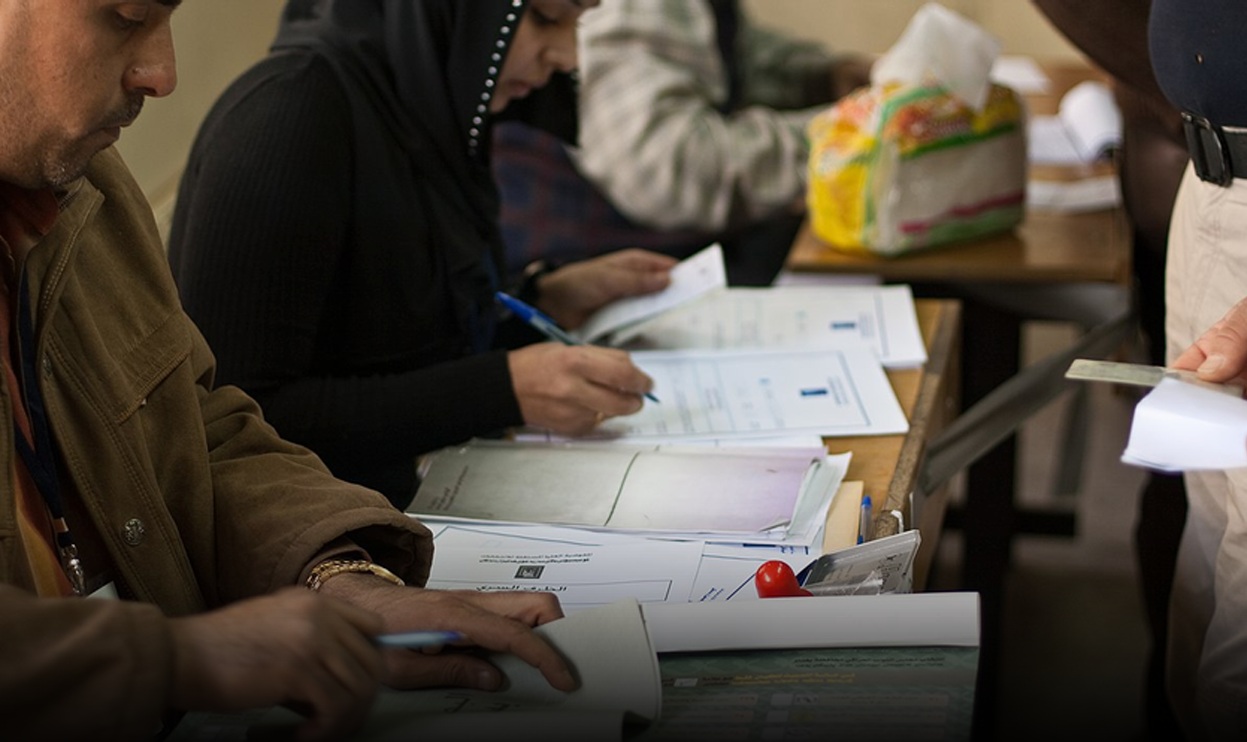
The Nineveh Provincial Council comprises 29 seats: 26 general seats elected on a constituency-wide basis by proportional representation (Sainte-Laguë method), plus three minority quota seats reserved one each for Christians, Yazidis, and Shabaks. The Council was suspended in 2019 along with all other Iraqi provincial councils, in response to the Tishreen ("October") protest movement, and remained dissolved until the 18 December 2023 governorate elections — the first such elections in over a decade.
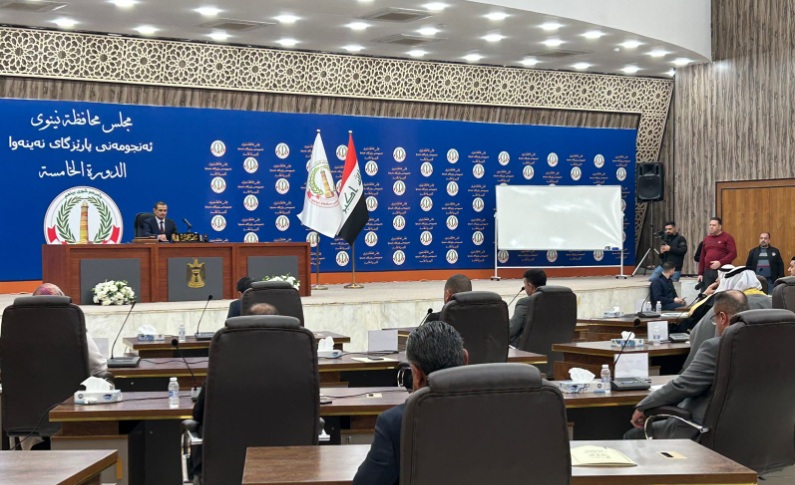
The 2023 election produced a fragmented but workable result. After several months of post-election negotiation, the Council elected on 22 July 2024 Mansour Marʿīd al-ʿAbdalī as Governor, drawn from a Sunni Arab list within the Nineveh People's Union, with 28 votes of the 39 cast in a session that 11 members boycotted (the slightly higher seat-counts reflect adjustments and alternates). Sirwan Mohammed Rozhbayani, an ethnic Kurd from the KDP, was elected First Deputy Governor with 26 votes. The election of the Second Deputy Governor was postponed and remained contested into 2025.
Council leadership turnover in Nineveh has been frequent throughout the post-2003 period. The post-2003 governors of Nineveh have included Osama Kashmoula (briefly, 2004, killed in ambush), Duraid Kashmoula (2005–2009), Atheel al-Nujaifi (2009–2014, removed by parliament after the fall of Mosul), Nofal Hammadi al-Sultan (2015–2019), Najim al-Jubouri (2019–2023, resigned to contest the 2023 election but barred from candidacy on debaʿthification grounds), and Mansour al-Marʿīd from 2024 onward.
v. The Sinjar Agreement (2020)
The single most-discussed political document specific to Nineveh in the post-2017 period is the Agreement on the Restoration of Stability and Normalisation of the Situation in the District of Sinjar, signed under United Nations Assistance Mission for Iraq (UNAMI) auspices on 9 October 2020 by the Iraqi federal government of then–Prime Minister Mustafa al-Kadhimi and the Kurdistan Regional Government of Prime Minister Masrour Barzani.
The agreement was negotiated against the backdrop of one of the gravest events in Iraqi modern history: the August 2014 Daesh assault on Sinjar, which the United Nations, the United States, the European Parliament and many other bodies have recognised as a genocide against the Yazidi community. An estimated 5,000 Yazidi men and older women were killed; 6,000 to 7,000 women and children were enslaved; and the resident population of Sinjar was almost entirely displaced. As of writing in 2026, an estimated 280,000 Yazidis remain in Duhok-governorate displacement camps, and approximately 2,700 Yazidi women and children abducted by Daesh remain unaccounted for.
The Sinjar Agreement rests on three pillars:
Security. All non-state armed formations — Yazidi, Kurdish, federal, and other — would withdraw from Sinjar District; security would be assumed by a newly-recruited local police force of approximately 2,500 men drawn from Sinjar's resident communities, supplemented by federal Iraqi army and intelligence personnel under federal command. Specifically named groups for withdrawal included the Sinjar Resistance Units (YBS) and other formations affiliated with the Kurdistan Workers' Party (PKK), as well as the Lalish-affiliated KDP units.
Administration. The two governments would jointly nominate, and the federal Council of Ministers would appoint, a single new mayor (qāʾim maqām) for Sinjar District — the existing parallel KRG-affiliated and PKK-affiliated administrations to be dissolved — with subsequent appointments for sub-district mayors and heads of departments. Local council elections would follow.
Reconstruction. A joint Sinjar Reconstruction Fund would be established under joint federal-KRG management, with an initial federal allocation of 28 billion Iraqi dinars (approximately US $18 million); reconstruction priorities — housing, schools, hospitals, water, electricity — would be jointly determined.
As of mid-2026, the implementation of the agreement remains substantially incomplete. Several non-state security actors retain a presence in the district. No single, mutually-agreed mayor has been appointed; an acting mayor based out of Duhok administers Sinjar at one remove. The Sinjar Reconstruction Fund has been only partially disbursed. Yazidi political representatives have repeatedly objected that the agreement was negotiated without their formal participation; in April 2023 Prime Minister Mohammed Shia al-Sudani allocated an additional 50 billion Iraqi dinars (roughly US $34 million) for Sinjar reconstruction, but disbursement remains contested. The U.S. Commission on International Religious Freedom, the United Nations, and several European governments have repeatedly urged faster implementation.
vi. Recent governance & the politics of reconstruction
Since the formal liberation of Mosul in July 2017, the politics of Nineveh has been dominated by three interlocking questions: who controls the security apparatus, who administers the disputed territories, and how the reconstruction of Mosul and the Old City is funded and directed.
On security, the Iraqi federal government has the formal lead, exercised through the Nineveh Operations Command of the Iraqi Army, the Federal Police, and the Counter-Terrorism Service. The Popular Mobilization Forces (PMF, al-Ḥashd al-Shaʿbī), formally constituted as a state body under Law 40 of 2016 but in practice composed of brigades with varying political affiliations, has substantial presence in western Nineveh, in the Nineveh Plain, in Tal Afar, and in Sinjar — including specifically constituted local brigades such as the Christian-led Babylon Brigade (Brigade 50), the Shabak Liwāʾ al-Shabak (Brigade 30), and the Yazidi Liwāʾ al-Sinjār (Brigade 80). The Kurdistan Region Peshmerga retain a presence on the eastern margin of Akre and Sheikhan. Turkish military forces operate against PKK targets in northern Sinjar, and have at times maintained the Bashiqa training base in Hamdaniya District (a presence that was itself politically contested).
On reconstruction, governance is shared among the federal Reconstruction Fund, the governorate administration, the United Nations Development Programme, UNESCO (which leads the "Revive the Spirit of Mosul" cultural-heritage initiative described in detail in our History entry), the United Arab Emirates (principal donor to the Al-Nūrī Mosque project), and a wide range of international and local NGOs. The political question is whose priorities prevail in selecting which neighbourhoods, religious sites, and infrastructure are rebuilt first — a question with direct demographic implications for the future of Mosul's mixed quarters.
On federal-KRG relations, the position of Nineveh remains a structural fault line. The Kurdistan Region's own internal politics — particularly the long-standing rivalry between the KDP and the PUK — is reflected within Nineveh through the relative weight given by Kurdish parties to alliances with Sunni Arab, federal, or PMF-affiliated lists. The 2023 provincial elections produced an outcome which observers interpreted as a strengthening of the Coordination Framework's allied bloc, with corresponding pressure on KDP-aligned positions in Sinjar and the Nineveh Plain.
vii. Subnational-autonomy proposals
Three distinct proposals for further administrative subdivision of Nineveh Governorate have been advanced since 2014, each with its own political constituencies.
The Nineveh Plain Governorate proposal calls for the elevation of Hamdaniya, Tilkaif, and Sheikhan districts (or some combination) to governorate status. The proposal has been championed primarily by Assyrian, Chaldean and Syriac Christian political parties — the Assyrian Democratic Movement, the Chaldean Syriac Assyrian Popular Council, the Bethnahrain Patriotic Union, and the Bethnahrain Democratic Party — on grounds that a Christian and minority-majority governorate would offer constitutional protection of a kind not achievable within either federal Nineveh or KRG control. The Iraqi Council of Ministers approved a proposal in principle on 21 January 2014, but the proposal was overtaken by the Daesh assault five months later. As of mid-2025, the four leading Suraye political parties have collectively renewed the call.
The Tal Afar / Jazīra Governorate proposal would elevate Tal Afar District to a governorate of its own. The proposal has principally Turkmen support, especially within the Iraqi Turkmen Front, although it has at various times also been backed by elements of the Sunni Arab leadership of the western Jazira. As noted above, Iraqi media reported on 27 April 2025 that the Council of Ministers was actively considering an initiative to elevate Tal Afar to a twentieth governorate under the name al-Jazīra; as of writing the proposal has not been finally enacted.
The Sinjar autonomous administration, by contrast, is not so much a proposal as an ad-hoc reality. Following the 2017 federal recovery of Sinjar, a self-administration structure tied to the Sinjar Resistance Units (YBS) has continued to function in parts of the district, distinct from both federal and KRG administration. Some Yazidi political leaders — notably figures associated with Êzîdxan parties — have called for this arrangement to be formalised as an autonomous district under Article 125. The Sinjar Agreement of 2020 was, in part, intended to dissolve such parallel structures; its incomplete implementation has had the effect of preserving them.
Whatever course these proposals take, the underlying political reality of Nineveh — a province whose demographic mosaic is unique within Iraq, whose territory carries both heavy historical weight and strategic significance, and whose recent trauma has not yet been politically processed — will continue to shape Iraqi national politics, and will continue to require especially careful and inclusive governance.
References
- Constitution of the Republic of Iraq (2005), Articles 117–125 (federal organisation, governorates) and Article 140 (disputed territories).
- Iraqi Council of Representatives, Law No. 21 of 2008, "Governorates Not Incorporated into a Region," as amended by Law No. 19 of 2013 and Law No. 10 of 2018.
- Mako, Shamiran (2021). "Negotiating Peace in Iraq's Disputed Territories: Modifying the Sinjar Agreement." Lawfare.
- International Crisis Group (2022). Iraq: Stabilizing the Contested District of Sinjar. Middle East Report N°235. Brussels.
- Chatham House (2024). Responding to Instability in Iraq's Sinjar District. Research paper.
- United States Institute of Peace (2023). "Iraq's Provincial Council Elections: The Way Forward in Nineveh Province."
- Washington Institute for Near East Policy (2024). "What Nineveh's Municipal Council Reveals about the Iran-Turkey Power Struggle in Iraq."
- Institute of Regional and International Studies, AUIS (2024). Iraq's Provincial Elections: Electoral Dynamics & Political Implications.
- Human Rights Watch (2023). Iraq: Political Infighting Blocking Reconstruction of Sinjar.
- UN Assistance Mission for Iraq (UNAMI) (2009). Report on the Disputed Internal Boundaries of Iraq.
- Atlantic Council (2021). "The Sinjar Agreement Has Good Ideas, but Is It a Dead End?"
- U.S. Commission on International Religious Freedom (2024). Annual Report 2024 — Iraq.
- Independent High Electoral Commission of Iraq (2023). Provisional and final results of the Provincial Council elections of 18 December 2023.
- Federal Supreme Court of Iraq, ruling of 2019 confirming the legal continuance of Article 140.
- Jongerden, J. & Zahawi, S. (2023). "Article 140 of the Iraqi Constitution and the Disputed Territories." In The Routledge Handbook of the Kurds.
- Kurdistan 24, "Iraq's Nineveh Provincial Council elects Mansour al-Mareed as new Governor," July 2024.
- SyriacPress (2025). "Suraye political parties call for establishment of Nineveh Plain governorate in Iraq."