A History of Mosul, in nine ages.
From the Assyrian capital of Nineveh on the eastern bank of the Tigris, through the medieval Atabegs and the long Ottoman centuries, to the city's modern reconstruction — a chronological survey, sourced and dated.
Mosul is a successor city. It rose on the western bank of the Tigris, opposite a vanished metropolis whose name it eventually claimed: Nineveh, capital of the Neo-Assyrian Empire and once the largest city in the world. The Arabic toponym al-Mawṣil — "the linking-place," from the verb waṣala, "to join" — describes precisely what the city has been across all its ages: a hinge between the two banks of a river, between the Mesopotamian plain and the highlands of Kurdistan, between the desert Jazira and the Christian, Yazidi and Kurdish uplands, between the Arab and the Turkic and the Persian spheres. Few cities in the world have spent so long at the intersection of so many worlds.
What follows is a chronological survey of that long inhabitation, divided into nine ages. Where dates and figures vary across sources, the variation is noted; where the historical record is uncertain, the uncertainty is preserved rather than smoothed away.
i. Antiquity & Nineveh — c. 6000 BCE to 612 BCE
The earliest settlement of the area dates to roughly 6000 BCE, when Neolithic communities established themselves on the eastern bank of the Tigris in a place that would become a religious centre devoted to the goddess Ishtar by the third millennium BCE. The name Ninua, the original form of "Nineveh," may derive from this association — a "House of the Goddess" — though the etymology remains debated. By the late third millennium and through the second, Nineveh appears in Assyrian texts as a provincial town of growing significance.
Architectural expansion accelerated under the Middle Assyrian kings Shalmaneser I (r. 1274–1245 BCE) and Tiglath-Pileser I (r. 1114–1076 BCE), but it was the Neo-Assyrian rulers from the ninth century BCE onward — Ashurnasirpal II, Tiglath-Pileser III, Sargon II — who transformed the city into one of the wonders of the ancient Near East. The decisive moment came in 705 BCE, when the new king Sennacherib transferred the imperial capital from Sargon's purpose-built city of Dur-Sharrukin to Nineveh and undertook a programme of construction of unprecedented scale.
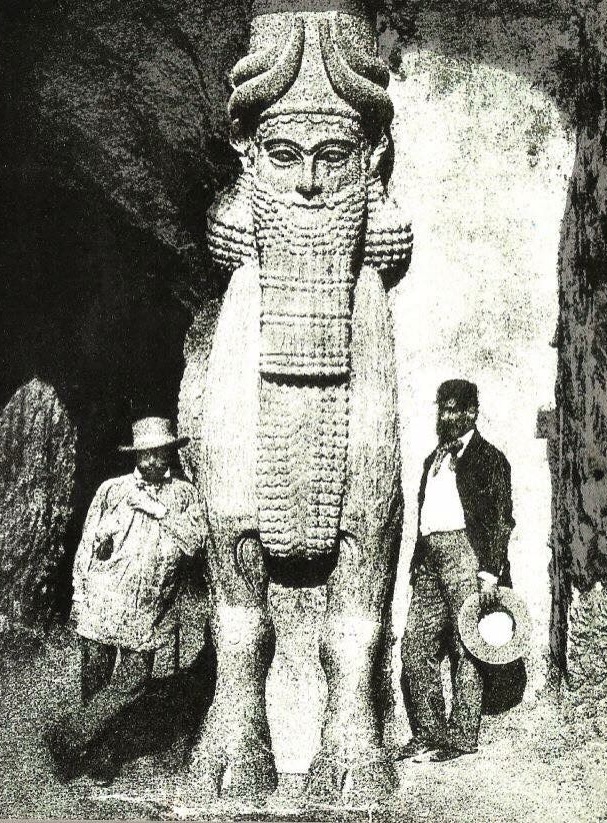
Sennacherib's "Palace Without Rival" (the Southwest Palace, in modern archaeological terminology) was constructed largely between 701 and 693 BCE on the citadel mound of Kuyunjik. It comprised some eighty rooms whose walls were lined with carved bas-reliefs in alabaster — over two thousand sculptured slabs in seventy-one rooms — depicting military campaigns, hunts, the construction of the palace itself, and processions of foreign tribute. At the principal gateways stood the colossal human-headed winged bulls and lions known as lamassu. The total walled area of Sennacherib's Nineveh was approximately seven hundred hectares (about 1,800 acres), and its twelve-kilometre circuit wall was pierced by fifteen great gates. An elaborate system of eighteen canals, fed in part by an aqueduct at Jerwan some forty kilometres away, brought water from the hills.
The British Assyriologist Stephanie Dalley has argued that the elaborate gardens Sennacherib built next to his palace, with their associated water-lifting works, were the original "Hanging Gardens" celebrated by Greek writers as one of the Seven Wonders — not a Babylonian construction at all, but a Ninevite one whose location was confused in later antiquity. The argument remains scholarly, but the gardens unquestionably existed: they are described in Sennacherib's own annals.
Under Sennacherib's grandson Ashurbanipal (r. 668–631 BCE) Nineveh reached its zenith. Ashurbanipal's North Palace contained reliefs of a different temper from his predecessors' — celebrated above all for the extraordinarily detailed lion-hunt cycle now in the British Museum. He also founded what is, alongside Alexandria, the most important library of antiquity: a systematic royal collection of cuneiform tablets gathered from temple archives across Babylonia and Assyria. Some twenty-two thousand fragments from this collection were recovered in the 19th-century excavations and form the basis of modern Assyriology, including the only complete extant copy of the Epic of Gilgamesh.
The greatness was short-lived. Ashurbanipal's death around 631 BCE was followed by civil war among his sons; vassal peoples saw their chance. In 612 BCE, after a long siege, a coalition of Babylonians, Medes and Scythians broke the city. The destruction was thorough: thick layers of ash sealed the palace floors, and the city, though never wholly abandoned, would never again be a capital. Within a generation it was a ruin. The biblical prophet Nahum's denunciation — "Nineveh is laid waste; who will mourn for her?" — captures the speed and totality of the fall.
ii. The Post-Imperial Centuries — 612 BCE to 7th century CE
For the next twelve hundred years, the eastern-bank ruins of Nineveh were a place where successive imperial frontiers passed by. Achaemenid Persia, the Hellenistic successors of Alexander, the Parthians and finally the Sasanians ruled in turn over the territory. The Greek soldier and historian Xenophon, marching past with the Ten Thousand around 401 BCE, saw the walls already crumbling and recorded the city's name as Mespila. Yet life continued: there were Hellenistic and Parthian settlements among the mounds, and the territory was reckoned an important agricultural region of the Sasanian frontier.
It was during these centuries that a new settlement began to take shape — quietly at first, then with growing importance — on the western bank of the Tigris, opposite the old eastern citadel. By the late Sasanian period this place was a fortified town the Syriac sources call Mawṣla; the sixth-century Christian writer Jacob of Edessa knew it as a substantial Christian centre. It became, in the early sixth century, the episcopal seat of the Assyrian Church of the East — the beginning of an unbroken Christian presence in Mosul that has lasted into the present day.
iii. The Islamic Conquest & Early Caliphate — 637 to 9th century CE
Mosul entered the Islamic era during the Arab conquests. The city was taken in 637 CE (some sources give 641) by ʿUtba ibn Farqad, a commander dispatched by the Caliph ʿUmar. Unlike many cities in the conquered Sasanian territories, Mosul kept its existing Christian population and its bishop in place; the Muslim conquerors built new neighbourhoods alongside the older town rather than displacing it. The new faith's first congregational mosque is said to have been built shortly thereafter on a site whose later replacement, the Umayyad Mosque, was rebuilt many times.
Under the Umayyads (661–750) Mosul became the administrative seat of the province of Diyār Rabīʿa — the "abode of the Rabīʿa" tribal confederation — and a key garrison on the Byzantine frontier. The Abbasid revolution of 750 brought the caliphal capital eastward to Baghdad and Samarra, but Mosul remained a major regional centre. Through the eighth and ninth centuries it grew into one of the most populous cities of the Islamic east, its position on the routes from Baghdad to Anatolia and onward to Syria making it a permanent commercial hinge. The Abbasid governors were drawn variously from Arab, Persian and Turkic backgrounds, and the city's polyglot character — Arabic, Syriac, Kurdish, Persian, Turkic — was already settled by 900.
iv. The Atabeg Golden Age — c. 905 to 1262
From the early tenth century onward Mosul passed through a series of locally-rooted dynasties whose collective achievement was to make the city one of the great cultural centres of the Islamic world. The Hamdanids (905–979), an Arab dynasty originating in the Mosul countryside, founded the line; they were succeeded by the Uqaylids (990–1096), and after a brief Seljuk interlude by the dynasty whose name has come to define the period — the Zengids, also called the Atabegs of Mosul.
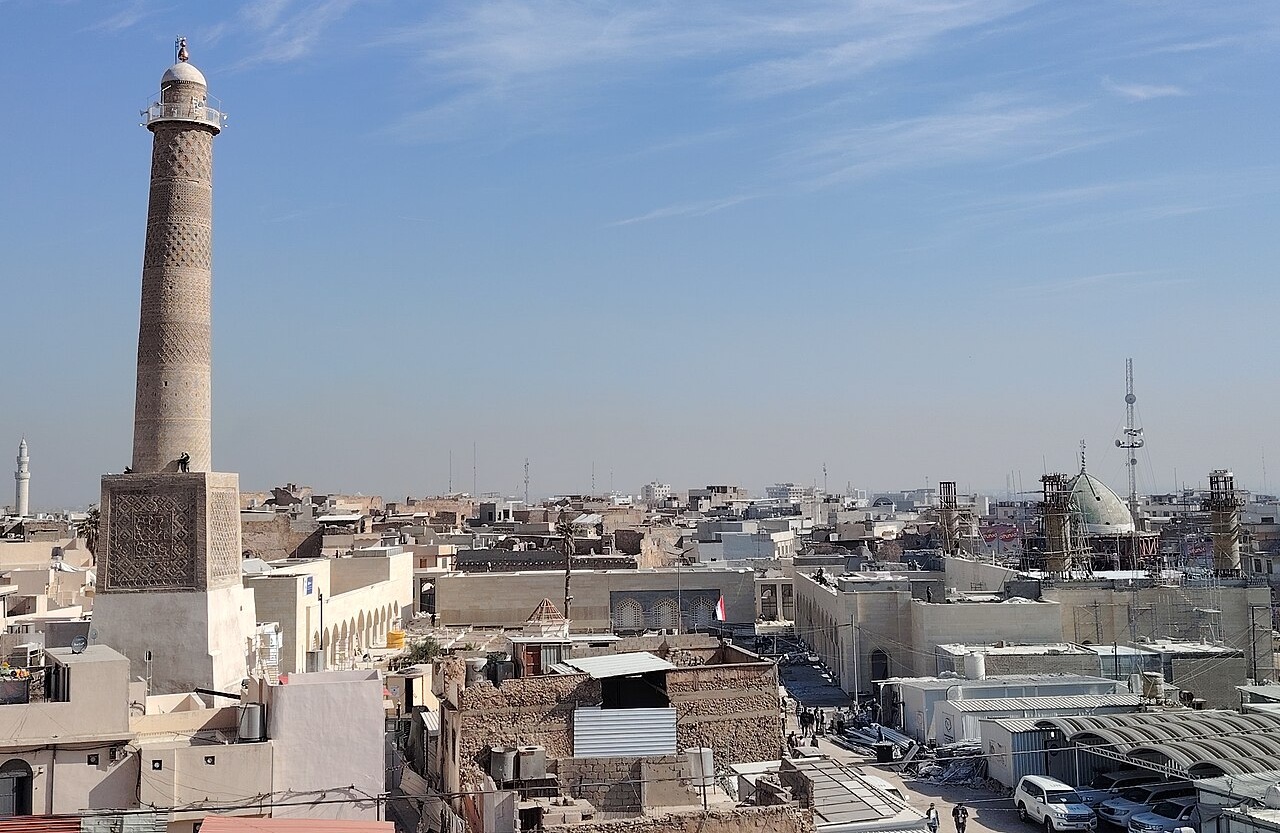
The founder of Zengid rule was ʿImād al-Dīn Zangī, appointed governor of Mosul in 1127 by the Seljuk sultan Mahmud II. From this base he and his successors built an Islamic state that contested Crusader power in Syria, took Aleppo and Edessa, and produced the lineage from which Saladin would ultimately emerge. The greatest of the Zengids in cultural terms was Nūr al-Dīn ibn Zangī, whose reach extended over Syria as well as the Jazira; in 1170–1172 he commissioned in Mosul the building that has defined the city's silhouette ever since: the Great Mosque of al-Nūrī, with its leaning brick minaret, al-Hadbāʾ — "the hunchback."
The 14th-century traveller Ibn Battuta passed through Mosul shortly after 1327 and described the minaret as already leaning — though its dramatic tilt almost certainly developed gradually over the centuries. The 19th-century traveller Grattan Geary wrote of it: "It is several feet out of the perpendicular, though it starts fair from the ground, and at the top, before putting on its gallery and dome, it regains an erect posture. Its attitude is that of a man bowing."
The Zengid line ended in administrative terms with the regency of Badr al-Dīn Luʾluʾ (1222–1259), a former slave who rose to become the effective ruler of Mosul and one of the most cultivated patrons in the medieval Islamic world. Under Luʾluʾ the city's celebrated school of metalwork — producing inlaid bronze and brass vessels of unmatched technical refinement, often signed by named craftsmen — reached its highest development. The "Mosul style" of inlay, characterised by silver and copper insets in finely engraved geometric and figural fields, spread to Aleppo, Damascus, Baghdad, Cairo and Iran, influencing Islamic metalwork for centuries. A second cultural achievement of the period was the Mosul school of manuscript painting, rivalled in Iraq only by the Baghdad school.
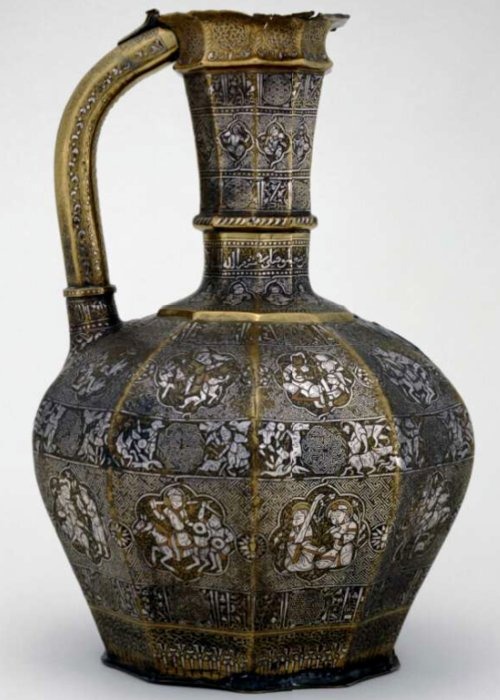
"It is on 14 September 1146 the Atabeg Imad ad-Din Zangi ibn Aq Sunqur, martyr for the Faith, ruler of Mosul and Syria, was killed…" — The Chronicle of Ibn al-Athīr, completed in Mosul, c. 1233.
The Mongol shock came late, comparatively. The Ilkhans subjugated the city in 1262, three years after the catastrophic sack of Baghdad. Mosul itself was not destroyed in the way Baghdad had been; Luʾluʾ's son Ṣāliḥ had submitted to the Mongols in 1258, and the city retained its administrative role under Ilkhanid governors. But the brilliance of the Atabeg period was over, and the city's economic position diminished as trade routes shifted away from a Mesopotamia now ruled from Tabriz and Maragha rather than Baghdad.
v. From Ilkhanid to Ottoman — 1262 to 1535
Through these two-and-a-half centuries Mosul belonged successively to a series of post-Mongol Islamic states: the Ilkhans, the Jalayirids who succeeded them in the 14th century, and from the early 15th century the Turkic confederations of the Qara Qoyunlu ("Black Sheep") and the Aq Qoyunlu ("White Sheep"). It was an age of contraction. The great agricultural and commercial machinery of the Abbasid heartland did not recover; population estimates for the city decline from earlier highs; and the architectural production of the period, while real, is far less ambitious than that of the Atabegs. Many buildings of this period were modifications of existing Atabeg structures rather than new foundations.
One enduring development of these centuries was the deepening differentiation among the religious communities of the surrounding plain. The Yazidis crystallised as a distinct community in the Sinjar and Sheikhan districts during the late medieval period; the Syriac Christian communities — East and West Syriac — preserved their dioceses through periods of dynastic instability; smaller Mandaean communities maintained their presence on the Tigris. By the early 16th century, when the Safavid Shah Ismaʿil briefly took Mosul in 1508, the religious landscape of the modern Governorate was substantially in place.
vi. The Ottoman Centuries — 1535 to 1918
The Ottoman annexation of Mosul came under Sultan Süleyman I, who took the city from the Safavids in 1535 during the campaign that also brought Baghdad under Ottoman rule. Mosul was made the capital of a vilayet (province) that, in its largest form, would extend from the Khabur valley in the west to the Lesser Zab in the east and from the Tur ʿAbdin in the north to the latitude of Tikrit in the south. Throughout the seventeenth and eighteenth centuries the city was the principal Ottoman frontier post against Safavid and later Qajar Iran.
Within Mosul itself, real political authority during the long eighteenth century rested less with appointed Ottoman governors than with a cluster of local notable families — the Jalili, the ʿUmari, the Tasin al-Mufti — who acquired through grain commerce, tax-farming and Janissary leadership a quasi-dynastic position. The most prominent of these were the Jalilis, descended from a Christian convert named ʿAbd al-Jalīl active in the late seventeenth century. From 1726, when his son Ismāʿīl became wālī (governor), the Jalilis governed Mosul effectively as a hereditary pashalik, with intermissions, until the Ottoman recentralising reforms abolished their position in 1834.
The high moment of Jalili rule was the defence of Mosul against the great Persian conqueror Nadir Shah. In September 1743, at the head of an army said to number over three hundred thousand, with hundreds of cannon and mortars and an improved siege train, Nadir besieged the city. The siege lasted forty days. Bombardment damaged the walls and started fires within; a premature general assault was beaten back by the defenders, who included Muslims, Christians and Yazidis fighting side by side. Hajj Ḥusayn Pasha al-Jalili directed the defence personally. After repeated failed assaults Nadir lifted the siege and withdrew — a defeat unique in his career, and unusual in being inflicted not by an Ottoman imperial army but by provincial forces. The city's walls and the towers known as Ij Qalʿa and Bash Tabya were repeatedly rebuilt and repaired by the Jalilis afterward, most extensively by Aḥmad Pasha al-Jalili in 1821.
The 19th century brought the Ottoman Tanzimat reforms, the gradual standardisation of provincial administration, telegraph and steamship lines, the new Vilayet system of 1864, and a slow modernisation of municipal infrastructure. By the late Ottoman period Mosul was a city of some seventy thousand inhabitants, with a substantial Christian quarter, distinct Jewish and Yazidi communities, and a flourishing commerce in Mosuli textiles — the cotton fabric known in Europe simply as mousseline took its name from the city. Gertrude Bell, who visited in 1909 and 1910, described its bazaars as among the finest in the Ottoman East.
vii. The Mosul Question & Modern Iraq — 1918 to 1968
The end of Ottoman rule came with the First World War. British forces under General W. Marshall occupied Mosul in November 1918 — just after the Armistice of Mudros, technically. The disposition of the former Mosul Vilayet became one of the most contested questions of the post-war settlement: claimed by the new Republic of Turkey under Mustafa Kemal, claimed by the British-administered Mandate of Iraq, and disputed at the League of Nations. The "Mosul Question" was finally resolved by the League's Frontier Commission in 1925 in favour of Iraq, and confirmed by the Treaty of Ankara in 1926. The decision was decisive in shaping the modern Iraqi state, since the territory contained the principal northern oilfields and the bulk of the country's Kurdish population.
Through the Hashemite monarchy (1921–1958) Mosul was a significant provincial capital but a comparatively quiet one in national politics. The republic of 1958 brought Iraqi nationalist politics more forcefully into the city; the short-lived Mosul Revolt of March 1959 against the central government of ʿAbd al-Karīm Qāsim ended in violent suppression and is remembered as one of the city's traumatic 20th-century moments. A more lasting development of the period was the founding of the University of Mosul in 1967, on the eastern bank of the Tigris — a major institution that grew to become one of the largest universities in the Middle East, and the principal academic engine of the city's modern intellectual life.
viii. The Baʿthist Era — 1968 to 2003
The Baʿthist coup of July 1968 inaugurated a period of thirty-five years during which Mosul, like all of Iraq, was governed from Baghdad under the Arab Baʿth Socialist Party and from 1979 by Saddam Hussein. The city benefited materially from the oil revenues of the 1970s — new neighbourhoods, a major expansion of the university, the construction of the Mosul Dam (completed 1986), modern hospitals and roads — but suffered, like the rest of Iraq, the ruinous sequence of the Iran-Iraq War (1980–1988), the 1991 Gulf War, and twelve years of international sanctions that hollowed out infrastructure and immiserated the population. Through these decades the demographic and confessional balance of the surrounding province was shaped by Baʿthist Arabisation policies, particularly in the Sinjar and Hamdaniya districts, whose long-term effects continue to be felt.
ix. The Recent Past & the Reconstruction — 2003 to the present
The American-led invasion of March 2003 reached Mosul in early April. The collapse of the Iraqi state was followed by a long, complex insurgency in which the city — with its mixed population, large former Baʿthist officer class, and proximity to the Syrian border — played a central role. Mosul became one of the strongholds of al-Qaeda in Iraq through the late 2000s, and from 2010 of its successor organisations.
On 10 June 2014 the city fell, with extraordinary speed, to the so-called Islamic State (Daesh). For three years it was the largest city under Daesh rule and the de facto capital of its self-proclaimed "caliphate." On 4 July 2014 Abu Bakr al-Baghdadi delivered from the pulpit of the Great Mosque of al-Nūrī a sermon declaring himself caliph — an act of symbolic appropriation that would ultimately have terrible consequences for the building.
The campaign to retake the city — the Battle of Mosul — was launched on 16 October 2016 by Iraqi Security Forces, with American, Kurdish and coalition support, against an estimated several thousand Daesh fighters. It was one of the largest, longest and deadliest urban battles since the Second World War. East Mosul was retaken by January 2017; the Old City and the western districts followed through a much harder fight, neighbourhood by neighbourhood, often house by house. On 21 June 2017, with the battle in its final weeks and the Old City surrounded, Daesh fighters detonated explosives that destroyed the Great Mosque of al-Nūrī and brought down the leaning Al-Hadbāʾ minaret. Iraqi Prime Minister Haider al-Abadi declared on 10 July 2017 that the city was liberated.
The destruction was on a scale rarely visited on a major city in the modern era. United Nations damage assessments of the Old City alone counted over five thousand affected buildings, of which 490 were entirely destroyed and 3,310 severely damaged. Civilian casualties for the battle have never been definitively established — official Iraqi figures gave 2,600 civilian deaths, but independent investigations by the Associated Press and others estimated the true figure at between five and eleven thousand, with some assessments substantially higher.
The reconstruction effort that followed has been one of the most ambitious cultural-heritage operations of the early 21st century. In February 2018 UNESCO launched the "Revive the Spirit of Mosul" initiative, with the United Arab Emirates pledging $50.4 million for the rebuilding of the Great Mosque of al-Nūrī and the Al-Hadbāʾ minaret. The project, executed by Iraqi craftsmen with international technical support, recovered some 45,000 original bricks from the rubble of the minaret and reincorporated them into the rebuilt structure, along with over 115 unexploded devices that had to be removed from the site. The work was completed in November 2024, and the rebuilt Al-Hadbāʾ — restored to its leaning posture, the brick patterns of its seven decorative bands once more visible — was dedicated alongside the reopened mosque on 1 September 2025, in a ceremony attended by Prime Minister Mohammed Shia al-Sudani.
The mosque is one element of a much wider restoration. The Dominican Church of Our Lady of the Hour (al-Saʿa), the Syrian Catholic Cathedral of al-Tahira, the Yahya Abu al-Qasim shrine, and dozens of heritage houses in the Old City have been rebuilt or are under reconstruction. Yet large parts of the Old City remain in ruins as of this writing, and many displaced families have not returned. The University of Mosul, which was occupied by Daesh and severely damaged in 2017, has been rebuilt and is functioning; new institutions have arisen, among them Al-Hadba University, founded in the post-conflict period and named for the minaret whose long inclination over the city has now resumed.
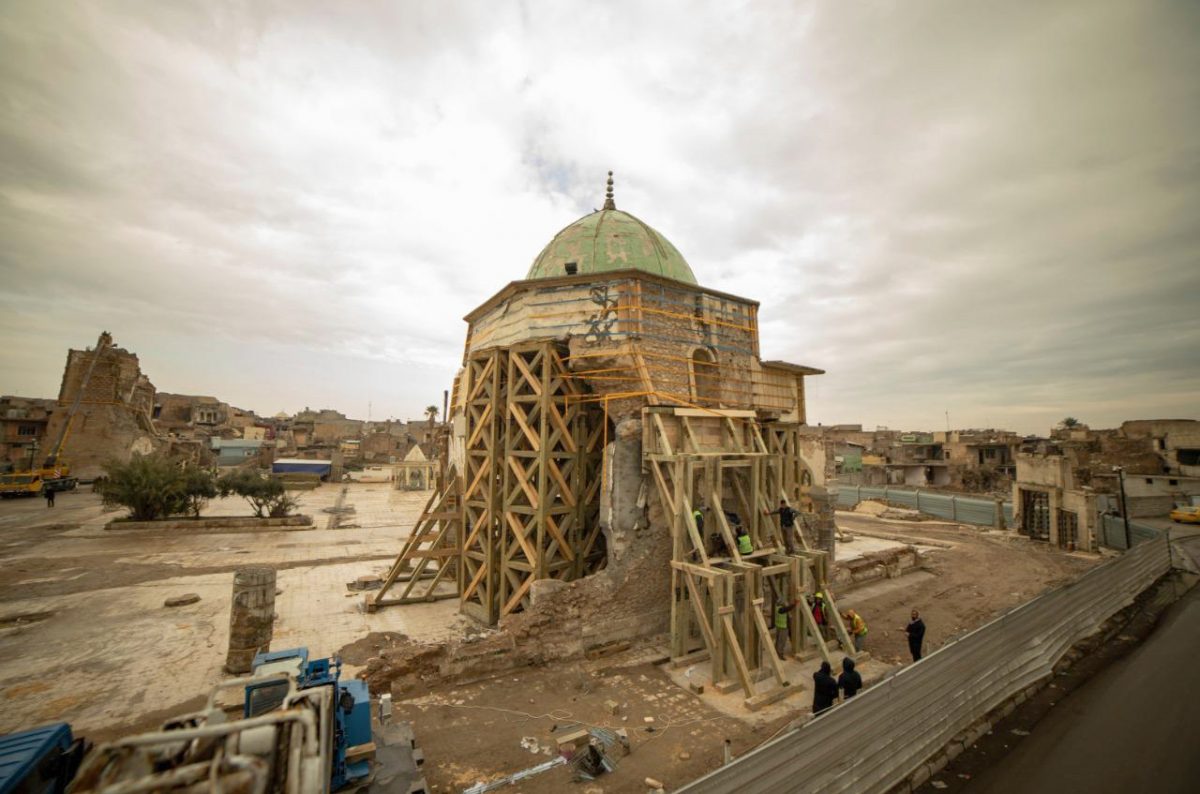
The history of Mosul, then, has not concluded; it has resumed.
References
- Reade, Julian E. "Nineveh," in The Reallexikon der Assyriologie, vol. 9 (Berlin: De Gruyter, 2000), pp. 388–433.
- Russell, John M. Sennacherib's Palace Without Rival at Nineveh. Chicago: University of Chicago Press, 1991.
- Dalley, Stephanie. The Mystery of the Hanging Garden of Babylon: An Elusive World Wonder Traced. Oxford: Oxford University Press, 2013.
- Radner, Karen. Ancient Assyria: A Very Short Introduction. Oxford: Oxford University Press, 2015.
- Frahm, Eckart. Assyria: The Rise and Fall of the World's First Empire. New York: Basic Books, 2023.
- Robinson, Chase F. Empire and Elites After the Muslim Conquest: The Transformation of Northern Mesopotamia. Cambridge: Cambridge University Press, 2000.
- Khoury, Dina Rizk. State and Provincial Society in the Ottoman Empire: Mosul, 1540–1834. Cambridge: Cambridge University Press, 1997.
- Olson, Robert. The Siege of Mosul and Ottoman-Persian Relations, 1718–1743. Bloomington: Indiana University Publications, 1975.
- Longrigg, Stephen Hemsley. Four Centuries of Modern Iraq. Oxford: Clarendon Press, 1925.
- UNESCO World Heritage Centre. "Old City of Mosul," tentative list submission (2018).
- UNESCO. Revive the Spirit of Mosul: Progress Report (Paris: UNESCO, 2024).
- Ibn al-Athīr (d. 1233). al-Kāmil fī al-Tārīkh. Various editions.
- Ibn Battuta (d. 1369). Riḥla. Trans. H.A.R. Gibb & C.F. Beckingham, 5 vols., Hakluyt Society, 1958–2000.
- al-ʿUmarī, Yāsīn (d. c. 1820). Tārīkh Āthār al-Jaliyya fī Ḥawādith al-Arḍiyya. Manuscript chronicle of the Jalili period.
- al-Diwahjī, Saʿīd. Tārīkh al-Mawṣil. Mosul: 1958.
- United Nations Institute for Training and Research (UNITAR). Damage assessment of Mosul Old City, 6 July 2017.
- U.S. Army Modern War Institute. Urban Warfare Project Case Study #2: Battle of Mosul, 2022.