The Infrastructure of Nineveh.
Five bridges across the Tigris, a re-opened international airport, the largest dam in Iraq, a power grid that has been broken and partly rebuilt, and a river of underground systems — water, sewage, fibre — on which a city of 1.8 million depends. A survey of how Nineveh moves, drinks, lights itself, and connects.
Infrastructure is the part of any city that is least visible until the moment it fails. In Nineveh, it has failed and been reconstructed within living memory more recently than perhaps any major Iraqi province. Between June 2014 and July 2017, large sections of the Mosul road network, all five of its Tigris bridges, the international airport, much of the electricity grid in the western half of the city, and substantial portions of the water and sewage networks were destroyed or damaged in fighting that left, by United Nations estimates, between fifty and seventy-five per cent of the western districts of Mosul wiped from the map. The decade since has been a slow, expensive, frustrating, and visible recovery — one bridge at a time, one substation at a time, one airport rebuild stretching over more than five years to the rebuilt international airport's reinauguration in July 2025.
This entry sets out the principal components of that infrastructure as it stands in mid-2026, the trajectory by which it has been rebuilt, and the work that remains. The Mosul Dam is treated in detail in the Geology entry; here it appears principally as the foundation of the electricity system. The reconstruction of cultural heritage — the Al-Nūrī Mosque, Al-Hadbāʾ minaret, churches and historic streets of the Old City — is treated in the Heritage entry. What follows is the engineering substrate on which the rest of the city's life rests.
i. Overview & the legacy of the 2014–2017 collapse
Before the events of 2014, Nineveh's infrastructure rested on a layered Iraqi-state inheritance. The principal trunk roads were national-government assets administered by the Ministry of Construction and Housing; the bridges of Mosul were assets of that ministry's Directorate of Roads and Bridges; the electricity system fed off the Mosul Dam and from connections to the national grid administered by the Ministry of Electricity; the water and sewage networks were operated by the Nineveh Directorate of Water; the airport was administered by the Iraqi Civil Aviation Authority. This division of responsibility, common across Iraqi governorates, was made workable in normal times by a degree of professional cooperation between governorate, federal ministries, and (after 2003) governorate-level Provincial Council oversight.
The June 2014 fall of Mosul to Daesh, the consolidation of the so-called caliphate, and the long campaign for its recovery between October 2016 and July 2017 destroyed not only physical assets but the working relationships that had maintained them. Every one of Mosul's five Tigris bridges was at least partially damaged; two were completely destroyed. The international airport, used as a Daesh military base, was deliberately sabotaged on retreat: trenches were carved across the runways, the terminal and control tower were stripped or blown up, the perimeter was mined. Power generation continued through the period, but transmission and distribution within Mosul collapsed. Western Mosul's water network was rendered inoperable; sewage backed up into ruined neighbourhoods; the road network through the Old City became impassable to ordinary vehicles.
Reconstruction since 2017 has been organised principally through the federal Reconstruction Fund for Areas Affected by Terrorist Operations (REFAATO), the United Nations Development Programme's Funding Facility for Stabilization (FFS), and bilateral programmes from Germany, the United States, the United Arab Emirates, the Republic of Korea, France, Italy, Turkey, the World Bank, and others. It has not been uniform; what is in the press tends to be the bridge or the airport with international funding and a ribbon-cutting; what is less visible is the long-tail work of reconnecting hundreds of small primary water lines, replacing transformers in ruined neighbourhoods, and laying fibre under streets paved over by repeat layers of asphalt.
ii. The five bridges of Mosul
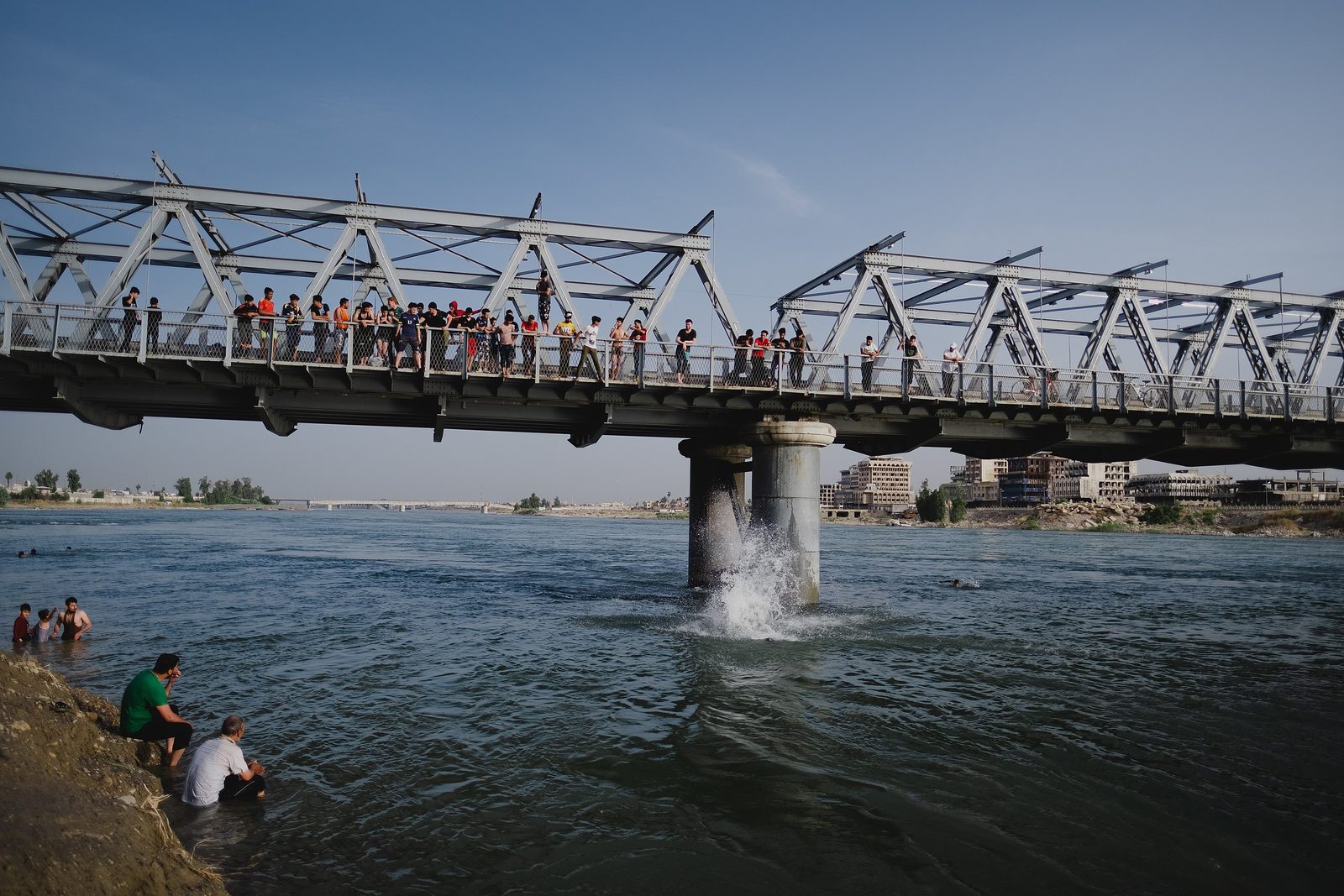
Mosul straddles the Tigris. The eastern bank, with the University of Mosul, the major modern hospitals, and the bulk of the city's expansion since the 1970s, was less damaged in 2014–2017; the western bank, with the Old City, the major commercial markets, and most of the historic religious heritage, took the brunt of the destruction. Connecting the two banks are five road bridges, named numerically in order of their construction; the working life of the city depends on them.
The 1st Bridge, also known as the "Old Bridge" or Jisr al-Hadīd (Iron Bridge), was constructed in 1932 and opened in 1934. At 305 metres in length, connecting the Naṣr and Maydān quarters, it is the city's oldest standing bridge across the Tigris and the first to be fully repaired and reopened to traffic after 2017. For the first two years after liberation, it was the only fully functional Tigris bridge in Mosul, channelling almost all east-west traffic across a structure not designed for the loads now placed upon it. It cannot accommodate large trucks. As of mid-2026, with the other bridges restored, the 1st Bridge has resumed something closer to its historical role of one route among several.
The 2nd Bridge (al-Muthannā), the 4th Bridge (al-Faiṣalliyya), and the 1st Bridge together formed the principal World Bank–supported reconstruction package, financed under the broader Iraq Emergency Operation for Development Project (US $750 million envelope, of which the bridge component was a part). World Bank–funded restoration of the three bridges was implemented by the Iraqi Ministry of Construction and Housing, with the Provincial Council of Nineveh as the local interlocutor; the 2nd and 4th bridges were progressively returned to full service through 2019–2022.
The 3rd Bridge (sometimes called al-Ḥurriyya al-Jadīd, "the New Liberty Bridge") was partially restored after 2017, but for several years operated only at reduced capacity — two lanes of the original four. Final upgrade and full restoration is being undertaken in stages; as of writing it is in service but with continuing intermittent restrictions. The 5th Bridge (Jisr al-Ḥurriyya, the northernmost), which carries traffic across to the eastern industrial and residential expansion, was restored in 2018–2019 and is now in regular service.
Beyond these five road bridges, Mosul's urban network includes a number of smaller bridges crossing the Khōsr (Khosar) River, which flows from east to west through the eastern half of the city before joining the Tigris. The Khōsr bridges were less catastrophically affected than the Tigris bridges but several required repair after 2017. Outside Mosul, the Gwēr and al-Qayyāra bridges to the south, which carry the principal road traffic between Mosul and the southern districts and onward toward Erbil, were damaged in 2014–2017 and have been progressively restored.
iii. The road network and surface transport
Beyond the bridges themselves, the principal road infrastructure of Nineveh consists of a small number of national-trunk corridors linking Mosul to Baghdad to the south and to the Turkish border at Ibrāhīm al-Khalīl crossing to the north, supplemented by governorate roads connecting the nine districts. The most strategically important of these corridors is the Mosul–Baghdad expressway, which passes through al-Qayyāra (in southern Nineveh) and onward through Tikrit and Bayjī to the capital. Northbound from Mosul, the route to Duhok and onward to the Turkish frontier is the principal corridor for cross-border trade in goods to and from Turkey, with the Ibrāhīm al-Khalīl crossing one of the busiest commercial border crossings in Iraq.
Most of these trunk corridors have been restored to a basic level of operability since 2017, although surface quality varies; the road inside Mosul itself, particularly through the Old City, remains in many places below pre-2014 standard. Within the eastern half of the city the network is largely functioning; in the western half, ongoing reconstruction of housing and commerce has been outpaced in places by the slower work of repaving streets and replacing the underlying water and sewage networks beneath them.
Public transport in the Governorate is dominated by minibuses (kīā) and shared taxis. There is no metro or light-rail service. A long-discussed proposal for a Mosul–Duhok rail line, originally proposed by the Iraqi Investment Commission with capacity for one million passengers and 55 million tonnes of goods per year over 167 km of two-way line, has not progressed beyond planning. Passenger rail service to Mosul on the historic Baghdad-Mosul-Aleppo line has been suspended since long before 2014 and has not been restored.
iv. Mosul International Airport
Mosul International Airport (IATA: OSM; ICAO: ORBM), located in southwestern Mosul, has had three lives. It originated in the 1920s as a Royal Air Force airfield, was rebuilt as a civil airport in 1990 (with the upgrade of the runway from asphalt to concrete and the construction of a new terminal), and was further upgraded to international Category 1 status with major renovations completed in 2007 — reopening to international civilian flights on 2 December 2007. From 2007 to 2014 it was a regional airport with limited but regular service, principally to Baghdad and to a small number of regional destinations.
Daesh captured the airport on 9 June 2014, on the day Mosul fell, and used it as a military base for nearly three years. On 23 February 2017, Iraqi forces — led by the Federal Police — recaptured the airport in approximately four hours of fighting, as part of the offensive that began on 19 February 2017 to retake western Mosul. The retreating Daesh forces had carved deep trenches across the runways, sabotaged the apron, and damaged or destroyed the terminal, the air-traffic control tower, and most ground equipment. Satellite imagery from October 2016 (taken before the recapture) had documented the runway sabotage in detail. De-mining operations on the airport site were not completed until November 2019.
Reconstruction of the airport was the largest single transport infrastructure project of the post-2017 period in Nineveh. The Iraqi Civil Aviation Authority signed a memorandum of understanding on 27 December 2020 with Aéroports de Paris Ingénierie (ADPI) and SEA Milan Airports for the reconstruction; financing was provided through French and Italian government loans. Implementation was undertaken on the ground by two major Turkish contractors — TAV İnşaat and 77 İnşaat — with debris removal beginning in late 2022 and runway reconstruction commencing in December 2022. The cabinet of Prime Minister Kadhimi laid the formal foundation stone in 2022; the cabinet of Prime Minister Sudani allocated US $150 million for phase one of the project (within a US $5 billion first-stage Mosul reconstruction budget).
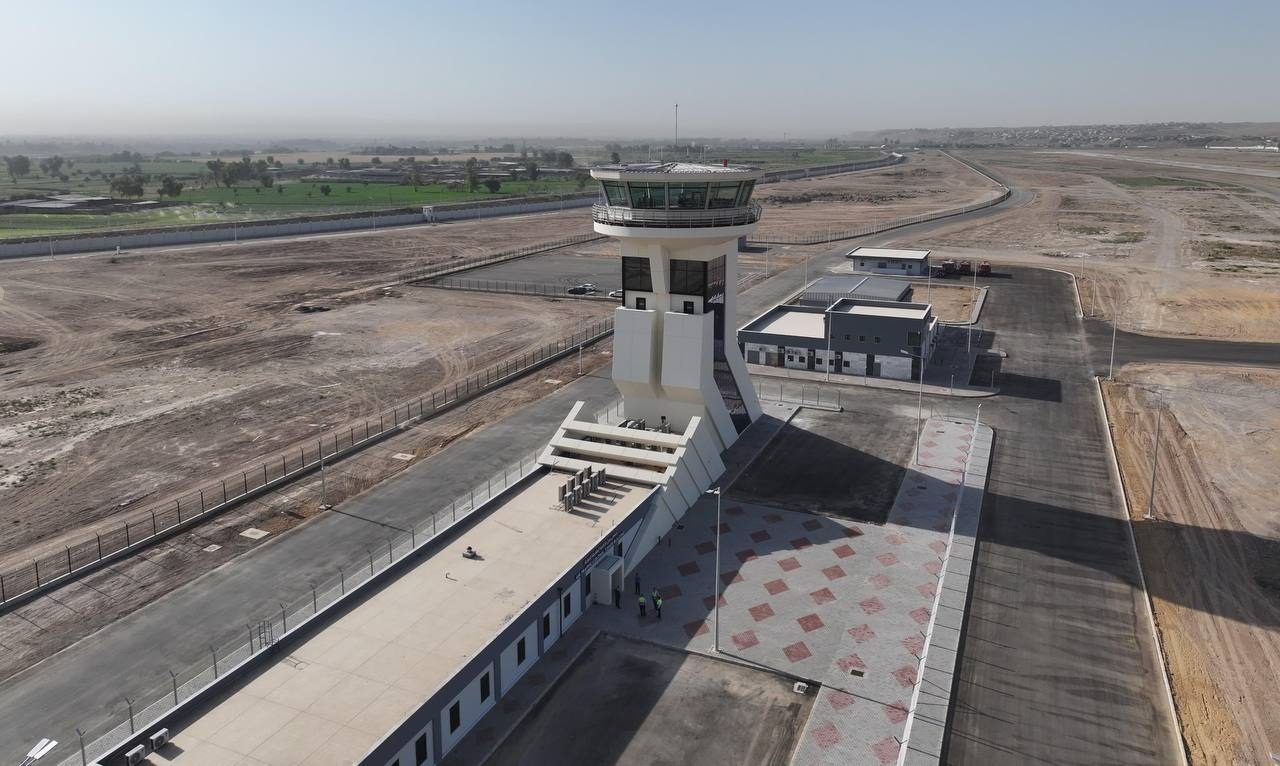
The reconstructed airport was inaugurated by Prime Minister Mohammed Shia al-Sudani on 16 July 2025. A trial flight by Iraqi Airways had landed on 5 June 2025; the formal first commercial flight followed on 6 November 2025 from Baghdad. Iraqi Airways was the launch carrier; commercial service to Erbil, Baghdad, and a limited number of regional destinations resumed through autumn 2025 and into 2026. The reconstructed facility includes a 3-km extended and widened runway, a rebuilt main terminal, a new air-traffic control tower, fire stations, maintenance facilities, perimeter fencing, an advanced radar surveillance system, and a VIP lounge. Designed annual capacity is 630,000 passengers and 30,000 tonnes of cargo.
For the residents of Nineveh — estimated at approximately four million in the airport's catchment — the practical effect is to remove a long-standing requirement to travel to Erbil or Baghdad for any flight. The economic case made by the Iraqi Ministry of Transport and the Sudani government has emphasised the airport's role in reviving tourism, in supporting the return of Mosul-origin diaspora, and in trade and cargo logistics. Whether traffic volumes in 2026 and beyond reach designed capacity will depend on factors beyond the airport itself: the security situation, the broader recovery of Mosul as a destination, and the carriers' confidence in committing aircraft.
v. Electricity: the Mosul Dam & the Nineveh grid
The Nineveh electricity system has two structurally distinct components: a generation system anchored on the Mosul Dam multi-purpose project, and a transmission-and-distribution network connected to the Iraqi national grid. Both components were affected by the 2014–2017 events, the first less catastrophically than the second.
The Mosul Dam generation complex, located approximately 50 km northwest of the city of Mosul on the Tigris (its geological setting is treated in detail in our Geology entry), comprises three hydroelectric power stations:
Mosul 1, the main hydroelectric station at the toe of the dam on the western abutment, contains four Toshiba Francis turbine-generators of 187.5 MW each, for an installed capacity of 750 MW. Construction commenced in 1981 with commercial operation from 1986. Annual generation in normal operation is approximately 2,420 GWh.
Mosul 2, the regulating dam downstream of the main embankment, comprises four Elin EBG Motoren 15 MW Kaplan-bulb turbine-generators for an installed capacity of 62 MW. The regulating dam was commissioned in 1985; its purpose is to regulate the tailwaters of the main dam and to generate additional power. Annual generation is approximately 346 GWh.
Mosul 3, the pumped-storage facility immediately upstream of the main dam, has an installed capacity of 240 MW with two reversible Francis turbines of 120 MW each, drawing on a small reservoir above Lake Dahūk. It functions as a peaking station, pumping water during off-peak hours and generating during peak demand. The total installed capacity of the Mosul Dam multi-purpose project is therefore 1,052 MW.
The dam's generation continued through the 2014–2017 events, except for the period of approximately ten days in August 2014 during which Daesh held the dam itself, before the joint Iraqi army–Peshmerga operation of 17 August 2014 (supported by United States airstrikes) recovered it. What was disrupted was not generation but transmission: high-voltage lines and substations within Mosul were damaged or destroyed, and rebuilding has been one of the long-tail components of the post-2017 reconstruction. The Iraqi Ministry of Electricity, with support from the World Bank, the Republic of Korea, and other partners, has progressively rehabilitated transmission and distribution infrastructure across Mosul; rural areas of Sinjar, parts of Tal Afar, and southern Hatra remained under-served as of 2024.
Beyond the Mosul Dam, Nineveh's electricity supply depends on connections to the Iraqi national 400-kV grid. National grid stability has been a chronic concern across Iraq, with rolling blackouts and seasonal demand-supply gaps a feature of summer in particular. A nationwide blackout in March 2026 affecting all governorates illustrates the broader fragility on which Nineveh's local supply rests. Local rooftop solar photovoltaic installation has expanded markedly across Mosul since 2020, but as a supplementary rather than principal source.
vi. Water, sanitation & the Tigris regulation
Water in Nineveh is, by Iraqi standards, in less precarious supply than in the central or southern provinces; the Tigris carries a substantial flow through the centre of Mosul, the Mosul Dam reservoir of 11.11 km³ provides large-scale regulated storage, and the Greater Zāb tributary contributes additional water from the eastern foothills. The Tigris flow at Mosul under natural conditions averaged approximately 22.2 km³/year before the 1984 commissioning of significant Turkish upstream impoundments; current flows are substantially reduced, particularly in summer, but Mosul's per-capita water availability remains higher than in much of southern Iraq.
The principal water-treatment infrastructure for Mosul consists of several large treatment plants drawing from the Tigris, the largest of which serves the city's western half. These plants and the network of primary and secondary water mains they feed were extensively damaged in 2014–2017; one of the early priorities of post-2017 reconstruction, supported by UNICEF, UNDP, and bilateral donors, was the restoration of treatment-plant capacity and the repair of major water-main breaks. By 2026 the urban network is substantially reconnected, although service intermittency — whereby individual neighbourhoods receive water on alternating-day schedules — remains a fact of daily life for many residents.
The Mosul Dam, in addition to its hydroelectric and flood-control roles, supplies regulated irrigation water to three downstream irrigation projects in the Nineveh and adjacent governorates. The Tigris's natural variability — with spring snowmelt peaks from the Taurus often historically exceeding sustainable channel capacities, and summer baseflows dwindling under evapotranspiration and upstream diversions — is partly smoothed by the dam's storage. Outside the irrigated zones, agriculture in Nineveh depends substantially on rainfed cultivation, with all the climate-vulnerability that implies.
Sanitation infrastructure is, on the whole, less developed than the water network. Mosul has a partial sewerage system, with extensive coverage in newer eastern neighbourhoods and patchy coverage in the historic Old City and in older western quarters. The reconstruction of the sewerage networks beneath the destroyed western neighbourhoods has been one of the slow-tail components of the post-2017 recovery: rebuilding sewers requires either the demolition of buildings constructed over them, or the careful threading of new pipework through already-rebuilt streets. Several donor-funded programmes — particularly UNICEF's WASH (water, sanitation and hygiene) emergency programme — have addressed both the immediate cholera-prevention dimension of sanitation in returnee neighbourhoods and the longer-term rebuilding of sewage networks.
vii. Telecommunications & digital infrastructure
Nineveh's telecommunications infrastructure depends on two principal layers: a mobile-cellular layer operated by Iraq's three licensed mobile-network operators (Asiacell, Zain Iraq, and Korek Telecom), and a fibre-optic backbone administered by the state-owned Iraqi Telecommunications and Post Company (ITPC) and a number of private internet-service providers. As elsewhere in Iraq, the practical end-user experience of internet access is dominated by mobile-cellular data and by household-level shared-WiFi delivered by neighborhood-scale ISPs over a mix of fibre, microwave, and last-mile copper.
Cellular and internet service was substantially disrupted within the Daesh-held period of 2014–2017, with the occupying authority restricting and at times prohibiting telecommunications. Rebuilding from 2017 was the responsibility principally of the operators themselves, in coordination with the Iraqi Communications and Media Commission. By 2026, mobile-cellular coverage in Mosul, the major roads, and the principal district capitals is broadly equivalent to elsewhere in Iraq; coverage in rural Sinjar, western Ba'aj, and southern Hatra remains patchier. 4G/LTE service is now standard across the principal urban areas; 5G deployment is at a very early stage and largely confined to a small number of trial sites.
Internet penetration in Nineveh follows the Iraqi national pattern: high in urban areas, lower in rural ones, with significant gender and generational gaps in active use. Public-sector digitalisation initiatives — the rollout of the National ID card, online services from the Ministries of the Interior and Higher Education, e-government services through the Sudani government's Wujūh ("Faces") and related platforms — have begun to extend into Nineveh, although adoption is uneven. Universities, including the University of Mosul and Al-Hadba University, have invested in campus-level fibre and learning-management systems, with mixed but improving results.
viii. The governance of reconstruction
Underlying every component of the infrastructure described above is a question of governance: who decides what is rebuilt, in what order, with whose money, and to what standard. The official Iraqi answer rests on the federal Reconstruction Fund for Areas Affected by Terrorist Operations (REFAATO), the Liberated Areas Reconstruction Fund, the federal sectoral ministries (Construction and Housing, Electricity, Transport, Communications, Water Resources), and the Nineveh Governorate's Provincial Council and governor's office. The international answer rests on a constellation of partners: the UNDP Funding Facility for Stabilization (financed by Germany, Japan, the European Union, the United Arab Emirates, the United States, and others); the World Bank's Iraq Emergency Operation for Development Project; bilateral programmes from Germany via KfW, France via AFD, Italy, Korea, Turkey, and others; and a large number of international and Iraqi non-governmental organisations.
The principal weakness of this multilayered architecture is well-recognised. The combination of overlapping authorities, of donor preferences for visible "ribbon-cutting" projects over invisible underground systems, of the perennial Iraqi capacity-utilisation gap between budgeted and actually-spent reconstruction allocations, and of the political contests described in our Politics entry over which districts and which communities are prioritised, have made progress slower and less even than the headline funding figures suggest. The pledges of US $30 billion at the 2018 Kuwait International Conference for Reconstruction of Iraq did not translate cleanly into US $30 billion of completed infrastructure on the ground. The early 2024 announcement of a US $5 billion first-stage Mosul reconstruction budget by the Sudani government has tightened the link between funding and physical delivery somewhat, but the gap remains.
What has been achieved is nonetheless substantial and worth marking. Five bridges restored. The international airport rebuilt and reopened. Several thousand kilometres of road resurfaced. Multiple major hospitals rehabilitated (treated in detail in our Health entry). The water and electricity systems are functioning at a serviceable if intermittent level for the population that has returned. The work that remains — the long-tail rebuilding of the western Old City, the under-served rural districts, the modernisation of the sewerage and the consistent supply of summer electricity — is not glamorous, but it is what will determine whether the people of Nineveh experience the next decade as recovery or as continuing crisis.
References
- World Bank (2018). "Rehabilitation of three vital bridges in the heart of Mosul improves livelihoods for more than 1 million Iraqis."
- Al Jazeera (2019). "Mosul's damaged bridges frustrate residents & efforts to rebuild."
- KirkukNow (2019). "Mosul residents frustrated by slow progress in rehabilitation of city's vital bridges."
- Al-Monitor (2025). "Over 10 years after ISIS takeover, Iraq's Mosul Airport reopens: What to know."
- Al Jazeera (2025). "Iraq reopens Mosul airport 11 years after ISIL conflict, destruction."
- AGBI (2025). "Iraq's Mosul Airport rebuilt a decade after destruction."
- FL360 Aero (2025). "After 11 years, Iraqi Mosul International Airport ready to resume commercial operation."
- Iraqi News / Iraqi Ministry of Transport (2024). "Iraq to reopen Mosul International Airport in 2025."
- Anadolu Agency (2023). "Rebuilt by Türkiye firms, Iraq's Mosul Airport to resume flights."
- Wikipedia (2026). "Mosul International Airport"; "Mosul Dam"; "List of power stations in Iraq."
- Power Technology / GlobalData (2024). "Power plant profile: Mosul Main Dam, Iraq" and "Mosul Regulating Dam, Iraq."
- Global Energy Monitor Wiki (2024). "Mosul Dam hydroelectric plant" and "Mosul Dam Regulator hydroelectric plant."
- Iraqi Ministry of Construction and Housing (2024). Project supervision documents.
- Iraqi Ministry of Electricity (2023). Annual statistical reports on transmission and distribution.
- UNDP Iraq (2024). Funding Facility for Stabilization annual reports.
- UNICEF Iraq (2024). WASH programme reports.
- Iraqi Investment Commission (2018). Project briefings: Mosul–Duhok rail proposal; Nineveh refinery proposals.
- Aéroports de Paris Ingénierie / SEA Milan Airports (2020). Memorandum of Understanding for the reconstruction of Mosul International Airport.
- Reconstruction Fund for Areas Affected by Terrorist Operations (REFAATO). Iraqi Council of Ministers project lists.