The art of Nineveh.
From the colossal lamassu and lion-hunt reliefs of Assyrian Nineveh through the thirteenth-century Mosul School of inlaid metalwork; from twentieth-century Iraqi modernism, in which Mosul-born artists played a decisive part, to the Daesh destruction and the post-2017 revival now under way at the University of Mosul Faculty of Fine Arts and at the Şâne' creative space.
Visual art in Nineveh is older than nearly anywhere else on earth. The neo-Assyrian palace reliefs carved at Nineveh and Nimrud between the ninth and seventh centuries BCE are among the foundational works of world art — the moment when narrative pictorial sculpture, in the strict sense, was invented. Twenty-eight centuries later, Mosul produced one of the most distinctive workshop traditions of medieval Islamic art: the inlaid bronze and brass vessels of the thirteenth-century Mosul School, whose finest pieces sit today in the British Museum, the Louvre and the Hermitage. Between those two horizons stretches a continuous artistic life — manuscript illumination, calligraphy, mosque ornament, vernacular architecture, modern painting — that the events of 2014–2017 interrupted but did not end.
This entry surveys that history domain by domain: the Assyrian visual legacy, the medieval Mosul workshops, calligraphy and the Islamic book arts, the twentieth-century Iraqi modernist movement and Mosul's contribution to it, the formal art education established at the University of Mosul Fine Arts Faculty and the Mosul Fine Arts Institute, the destruction of 2014–2017, and the artist-led revival under way since. Material on the literary and musical sides of cultural life is in our Culture entry; material on the Mosul Museum's looted antiquities is in our Heritage entry.
i. The Assyrian visual legacy
The capital of the Neo-Assyrian Empire was at Nineveh from the reign of Sennacherib (r. 705–681 BCE) until the city's destruction by a Median-Babylonian coalition in 612 BCE. During those nine decades and the somewhat longer cultural horizon that included earlier capitals at Nimrud (Kalḫu) and Khorsabad (Dur-Šarrukin), the Assyrian court produced the most accomplished narrative pictorial reliefs of the ancient Near East. The walls of the South-West Palace of Sennacherib at Nineveh and of the North Palace of Ashurbanipal at the same site were lined with continuous registers of gypsum alabaster slabs, each carved in low relief and brilliantly painted (almost no original paint survives) with detailed scenes of military campaigns, royal hunts, court ceremonies, and the construction of the palaces themselves.
The art-historical importance of these reliefs cannot easily be overstated. They are the earliest surviving images that tell continuous stories pictorially — the conquest of Lachish, the marsh campaign against the Chaldeans, Ashurbanipal's lion hunts — with the same conventions of register, scale variation, and narrative sequence that would later structure Roman triumphal columns, Renaissance fresco cycles, and modern comics. They are the earliest surviving large-scale depictions of landscape, of animals in motion, of architecture in space, of war as collective enterprise. The lion-hunt panels from the North Palace of Ashurbanipal — the dying lioness with arrows in her spine, the lion crouching in agony — are among the most affecting representations of animal suffering in world art.
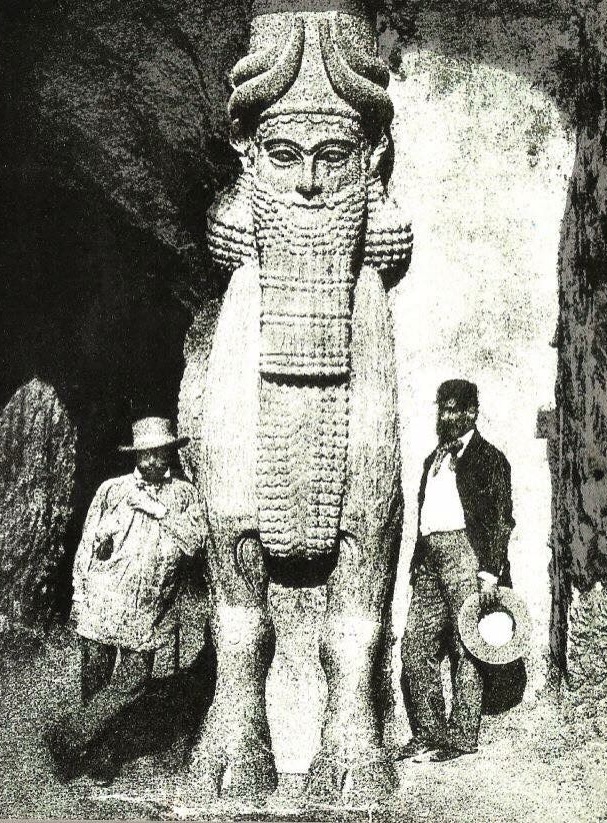
Guarding the palace entrances were colossal stone lamassu figures — winged human-headed bulls, carved at scales reaching five metres tall and weighing dozens of tonnes. The lamassu were apotropaic guardians, designed to look formidable from in front (where they appear in profile-and-frontal hybrid, with two legs) and animate from the side (where they appear in full profile with four legs walking, the fifth leg added so that all five are visible from each viewpoint). Pairs of lamassu flanked the gates of the city, the palaces, the temples; many were toppled at Nineveh's fall, others survived buried in the ruins until nineteenth-century excavations by Layard and Rassam.
The bulk of the surviving Assyrian reliefs left Iraq during those nineteenth-century excavations and now sit in the British Museum, the Louvre, the Pergamon Museum and a handful of other European and American collections; smaller pieces remained in Iraq and were the centrepiece of the Assyrian Hall of the Mosul Museum. The remaining in situ palace reliefs at Nineveh were protected under a modern roof from the 1970s; those at Nimrud and the palace gates of Nineveh were the principal targets of the Daesh demolitions of 2015, treated in our Heritage entry.
ii. The Mosul School of inlaid metalwork
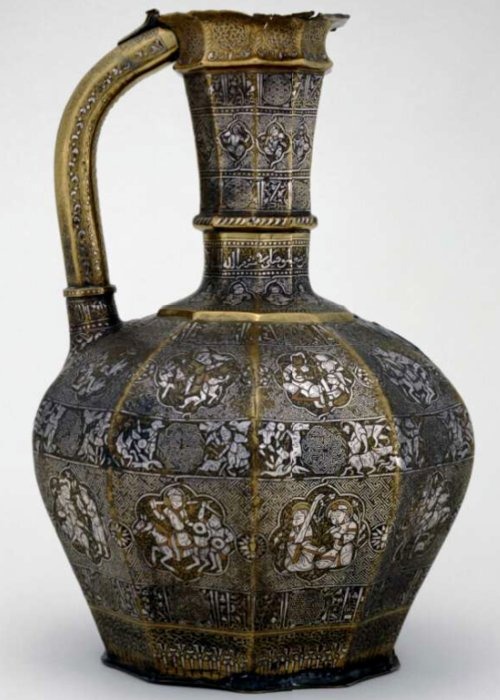
If the Assyrian reliefs are the first major chapter of Nineveh's visual art, the second is the Mosul School of inlaid metalwork (al-madrasa al-mawṣiliyya li-l-maʿādin al-muṭaʿʿama): a workshop tradition of bronze and brass vessels — ewers, basins, candlesticks, incense burners, pen-boxes — whose surfaces were chased and inlaid with silver, copper, and occasionally gold to produce ornament of remarkable density and refinement. The school flourished under Atabeg and Zangid patronage at Mosul through the late twelfth and the thirteenth centuries, reaching its high point under Badr al-Din Lu'lu' (r. 1218–1259), and influenced metalworking traditions as far afield as Cairo, Damascus, Aleppo and Persia.
The single most celebrated surviving object is the Blacas Ewer, signed by the craftsman Shujā' ibn Manʿa al-Mawṣilī and dated to the month of Rajab 629 AH (April 1232 CE) — among the earliest dated examples of Islamic inlaid metalwork to bear an artist's signature. The ewer (now in the British Museum, acquired in 1866 from the collection of the Duc de Blacas) stands 30 cm high and is a brass vessel inlaid with silver and copper. Its surface is divided into horizontal bands of medallions and inscriptions: friezes of mounted horsemen, polo players, musicians and feasting scenes alternate with bands of Kufic and Naskh calligraphy. The detail is astonishing — faces, gestures, costume, the curl of a horse's mane — in a medium (chased and inlaid metal) that resists detail. The Blacas Ewer stands as the canonical witness that the medieval Mosul workshops were a court tradition of the highest accomplishment.
Several other major signed Mosul pieces survive. The candlestick of Dā'ūd ibn Salama al-Mawṣilī (1248–49, now in the Louvre) bears the signature of one of the school's most accomplished masters, who later moved to Cairo and continued working under Mamluk patronage. The basin known as the "Baptistery of Saint Louis" — despite the name a fourteenth-century Mamluk Egyptian piece — descends directly from Mosul technique through that diaspora. The Bobrinsky Bucket (1163, made at Herat but in a style closely linked to the Mosul tradition) and the Vaso Vescovali (early thirteenth century) reflect the network of workshops that Mosul's craftsmen anchored.
The Mosul style is identified by several characteristic features: a dense surface organisation in horizontal bands; figural scenes drawn from courtly life rather than (as in some later traditions) restricted to abstract or vegetal ornament; meticulous use of silver inlay for highlights and copper inlay for warm tones; signed and dated inscriptions; and a particular treatment of human faces and costume that art historians can identify across pieces. The school's decline followed the Mongol shock of 1262 and the dispersal of its craftsmen to Cairo, Damascus and Persia, where they founded successor traditions.
iii. The Mosul School of Painting
Parallel to the metalwork tradition, Mosul produced a distinctive medieval tradition of manuscript painting — the Mosul School of Painting, treated also (in its cultural context) in our Culture entry. The school flourished briefly but intensely in the thirteenth century, principally under Atabeg patronage at the court of Badr al-Din Lu'lu'. Its surviving works are illuminations in scientific manuscripts — treatises on medicine, botany, astronomy — and in works of poetry and history. The palette is characteristic: dissolved reds, lapis blues, ochre yellows, gold leaf. Faces are full and rounded; figures are heavy and grounded; costume is rendered in granular detail; architectural settings are filled with everyday characters — cooks, physicians, court attendants — rather than only with the rulers being depicted.
The Mosul painting school is distinguished from contemporary Seljuq and Baghdadi schools by its heightened sense of figural realism, its developed costume and architectural detail, and its impulse to populate scenes with figures of daily life. The most celebrated surviving example is a twelfth-century medical illumination (now in Paris) showing four figures arrayed around a seated physician. The Mongol invasion of 1258, reaching Mosul in 1262, ended the school as a continuous tradition; its influence on the successor Ilkhanid school of Persian painting was substantial.
iv. Calligraphy and the Islamic book arts
Arabic calligraphy is the highest of the Islamic visual arts, and Mosul has been an important calligraphic centre for most of the millennium since the city's incorporation into the Abbasid world. The earliest Quranic manuscripts produced at Mosul are in the angular Kufic script that dominated Arabic calligraphy through the tenth and eleventh centuries; the Mosul Museum and major international collections hold examples. From the twelfth century onward, the city's calligraphers worked principally in the cursive scripts — Naskh for general manuscript copy and continuous prose, Thuluth for monumental display and architectural inscriptions, Muḥaqqaq for fine Quranic copy. The inscriptions on the medieval inlaid metalwork discussed above are a parallel calligraphic record: the signed Mosul pieces include some of the finest miniature calligraphy of their period.
The Ottoman centuries saw Mosul integrated into the broader Istanbul-centred world of Islamic calligraphic training, with Mosuli calligraphers studying with masters in Baghdad and Istanbul and Mosuli patrons commissioning Quran copies, religious inscriptions for the al-Nuri Mosque and the city's smaller mosques, and architectural decoration for mosques and houses across the Old City. The mosques of Old Mosul bore some of the finest calligraphic inscriptions of nineteenth-century Iraq. Many of these inscriptions were lost or damaged during the 2014–2017 destruction; restoration is treated in our Heritage entry, with the work of recreating monumental calligraphic panels carried out by Mosuli and Egyptian master calligraphers as part of the UNESCO Revive the Spirit of Mosul programme.
Twentieth-century Mosuli calligraphers contributed to the ongoing tradition of Iraqi calligraphic art; the city's Fine Arts Institute (discussed below) maintains a calligraphy curriculum that continues to produce working masters. Contemporary Mosuli calligraphers also work in the secular tradition of ḥurūfiyya — a twentieth-century movement that uses Arabic letterforms as the basis for non-figurative painting and graphic art — alongside their traditional religious commissions.
v. Modern Iraqi art and Mosul's role
Modern Iraqi art emerged in the twentieth century as Iraq, in common with the rest of the Arab world, opened to European art education and gradually developed its own modernist movements. The decisive moment was the foundation of the Baghdad-based Society of Pioneers (Jamāʿat al-Ruwwād) in 1950 by Faiq Hassan, and the more influential Baghdad Group for Modern Art (Jamāʿat Baghdād li-l-Fann al-Ḥadīth) in 1951, founded by Jewad Selim and Shakir Hassan Al Said with the explicit programme of fusing modern European technique with the heritage of Mesopotamian art — the istiḥdāth turāth ("renewal of heritage") that has been the dominant thread of Iraqi modernism ever since. Selim's monumental sculpture Naṣb al-Ḥurriyya (Liberty Monument, 1959–61) in Baghdad's Tahrir Square is the most famous single work of Iraqi modernism, drawing explicitly on Assyrian relief composition.
Mosul contributed several major figures to this national tradition. Ismāʿīl al-Shaykhly (1924–2002), born in Mosul, was a founding member of the Baghdad Group for Modern Art and a long-serving professor at the Baghdad Institute of Fine Arts; his paintings, with their architectural simplification of Iraqi village life and use of warm earth-toned palettes, are central to the Iraqi modernist canon. Faruq Ḥassan (b. 1939), a Mosul-born painter and graphic artist, was a major figure in Iraqi modernism's second generation; his work draws on Assyrian iconography and the Mosul tradition of inlaid metalwork ornament transposed to canvas. Several Mosuli artists were students or associates of the major Baghdad modernists, returning to teach at the Mosul Fine Arts Institute and the University of Mosul Faculty of Fine Arts.
Beyond these Baghdad-affiliated figures, Mosul has had its own circle of working artists across the twentieth century — teachers at the Fine Arts Institute, members of the local fine-arts union, painters and sculptors with personal studios across the city. Their work has been less internationally visible than the Baghdad modernists' but constitutes a continuous local tradition: portraiture, landscape, religious subjects, abstract experimentation in ḥurūfiyya, calligraphy as fine art.
vi. Art education: the Fine Arts Institute and the University Faculty
Formal art education in Mosul is structured around two main institutions. The Mosul Fine Arts Institute (Maʿhad al-Funūn al-Jamīla bi-l-Mawṣil), part of the Iraqi vocational education system under the Ministry of Education, offers four-year secondary-level training in painting, sculpture, graphic design, ceramics, calligraphy, music and theatre. The Institute traces its origins to 1947 and has historically served as the principal pathway by which Mosuli young people enter the visual and performing arts. Many of its alumni have proceeded to the University of Mosul Faculty of Fine Arts for further training; others have gone directly into working studios, teaching posts at lower-secondary schools, or freelance practice.
The University of Mosul Faculty of Fine Arts (Kulliyyat al-Funūn al-Jamīla), established as part of the broader University, offers bachelor's and master's degrees across departments of painting and sculpture (al-funūn al-tashkīliyya), music, theatre, and aesthetic philosophy. The Faculty is housed in a purpose-built building in the medical-campus quarter on the right bank of the Tigris; like the rest of the University, it was extensively damaged during 2014–2017 and has been progressively rebuilt since. The Faculty's painting and sculpture department maintains a calligraphy curriculum, a graphic-arts curriculum, and undergraduate and graduate research in the history of Mosuli and Iraqi visual arts.
The Faculty's role in the post-2017 revival is significant. Its faculty members and graduates have led much of the documentation work on what was lost in 2014–2017, the recovery and restoration of damaged works, the training of a new generation of restorers and craftsmen for the broader heritage reconstruction (treated in our Heritage entry), and the participation of Mosul artists in the contemporary Iraqi art scene. Several of the artist-led initiatives discussed below originated in or are anchored by Faculty members or alumni.
vii. The destruction of 2014–2017
The events of 2014–2017 affected Mosul's visual-arts world along several axes. The most internationally visible was the destruction at the Mosul Museum on 26 February 2015, in which Daesh militants attacked the Assyrian and Hatra galleries with sledgehammers and pneumatic drills; the events are described in detail in our Heritage entry. Many of the museum's principal antiquities — the Lion of Nimrud, both lamassu pairs, the Banquet Stele, throne bases, monumental wall reliefs — were smashed, irreparably damaged, or looted and dispersed onto the international antiquities market. The restoration consortium of the SBAH, the Louvre, the Smithsonian, the World Monuments Fund and ALIPH has been working since 2018 to reassemble what can be reassembled; the museum is scheduled for re-opening in 2026.
The destruction extended beyond the Museum. Public art in the city was a recurring target: monumental sculptures in city squares, public mosaics, calligraphic panels on the façades of public buildings, and the elaborate carved-stone and calligraphic ornament of mosques and churches. The destruction of the al-Nuri Mosque and the al-Hadbā' Minaret on 21 June 2017 (Heritage, § ii) included the loss of significant medieval calligraphic inscriptions; the restoration has involved the careful recreation of these inscriptions by Egyptian and Iraqi master calligraphers working under UNESCO supervision. The al-Saa Convent (Heritage, § iii) lost the bulk of its painting and decorative-art collection — including the Dominican-press publication archive and significant nineteenth-century devotional paintings — in addition to its structural damage. The al-Tahera Church (Heritage, § iii) lost much of its devotional art and ornament during the period of occupation and was structurally damaged.
Private studios, galleries, and personal collections across Mosul were dispersed or destroyed during the occupation. Artists fled, in many cases taking only what could be carried; others remained and stopped working publicly. The Fine Arts Institute and the University Faculty were closed; equipment and supplies were looted, archives destroyed. Many Mosuli artists describe the period as one in which their working practice ceased entirely, replaced by the simple work of survival.
viii. Post-2017 revival: the Faculty, the Şâne' creative hub, and the contemporary studios
The post-2017 revival of Mosul's visual-arts life has been led, in roughly equal measure, by three sets of institutions: the University of Mosul Faculty of Fine Arts, restored to operation and now training a new generation of Mosuli artists under restored faculty; the Mosul Fine Arts Institute, similarly restored and operating; and a set of artist-led private initiatives, of which the most prominent is Şâne'.
The Şâne' creative hub (Ṣānaʿ, "[she/he] made/created"), founded in June 2021 at the disused Mosul railway station, was established by a group of returning Mosuli creatives as a multi-purpose creative space hosting visual-arts exhibitions, performances, workshops, residencies and rehearsals. Şâne' was set up with UNESCO support but is principally a Mosul-based artist-run initiative; it has become the most visible single venue for contemporary visual art in the city. Its exhibition programme has included solo and group shows by Mosuli painters, photographers, sculptors and installation artists, alongside collaborations with visiting Iraqi and international artists. The cinema training programme treated in our Culture entry (Film Lab, established at the Mosul Fine Arts Institute in 2021 under UNESCO and EU support, in partnership with the Stadsschouwburg Gent) is a parallel artist-development initiative running through the formal art-education institutions.
The Mosul Book Forum (Culture, § iii) has hosted painting exhibitions, calligraphy workshops and live drawing sessions, complementing its literary programming. The reopened Mosul Fine Arts Union has begun coordinating exhibitions and supporting working artists. Private galleries, returned from displacement or newly established, have opened across the city; several have explicit programming around the recovery and renewal of Mosuli visual-arts traditions. A network of Mosuli artists working in diaspora — in Erbil, Baghdad, the Gulf, Europe and North America — have maintained connections to the city and contributed to its post-2017 revival through visiting workshops, exhibitions, and material support.
ix. The argument of continuity
The question that visitors to Mosul ask, looking at the rebuilt al-Hadbā' Minaret or at the reopened Mosul Museum (when 2026 arrives) or at a contemporary painting on the wall of Şâne', is whether what was lost between 2014 and 2017 can be made good. The honest answer is that some of what was lost cannot be: the smashed Assyrian fragments at the Museum are partly reconstructable but the lost provenance information and contextual integrity are not; the looted antiquities dispersed on the international market may be slowly recovered but not all will be; the personal libraries, private studios and lifetimes of working practice that were destroyed are simply gone.
What can be made good, and what is being made good, is the continuity of the artistic tradition itself: the line of teaching from master to student, the working practice of contemporary Mosuli artists, the formal education through the Fine Arts Institute and the University Faculty, the public spaces in which art is exhibited and discussed. The Şâne' creative hub at the railway station is a particular case in point: a working artist-led space, in a city that until very recently could not be said to have one. The reopened Book Forum, the restored University Faculty, the planned Museum reopening — these together are the institutional infrastructure within which a renewed Mosuli visual-arts tradition is taking shape. The art of Nineveh, in 2026, is not what it was in 2014; nor, however, is it what it was in 2017. The continuity of three thousand years of pictorial making along the right bank of the Tigris has been reestablished.
References
- Albenda, P. (1986). The Palace of Sargon, King of Assyria. Paris: Éditions Recherche sur les Civilisations.
- Russell, J.M. (1991). Sennacherib's Palace Without Rival at Nineveh. Chicago: University of Chicago Press.
- Russell, J.M. (1998). The Final Sack of Nineveh. New Haven: Yale University Press.
- Reade, J. (2018). Assyrian Palace Sculptures, revised edition. London: British Museum Press.
- Bahrani, Z. (2017). Mesopotamia: Ancient Art and Architecture. London: Thames & Hudson.
- Rice, D.S. (1957). "Studies in Islamic Metal Work — VI: The Mosul School." Bulletin of the School of Oriental and African Studies, 21(1/3): 487–504.
- Ward, R. (1993). Islamic Metalwork. London: British Museum Press.
- Allan, J.W. (1982). Islamic Metalwork: The Nuhad es-Said Collection. London: Sotheby's.
- British Museum (2024). "The Blacas Ewer" — collection record OA.1866,1229.61.
- Ettinghausen, R. (1962). Arab Painting. Geneva: Skira.
- Grabar, O. (1984). The Illustrations of the Maqamat. Chicago: University of Chicago Press.
- Shabout, N. (2007). Modern Arab Art: Formation of Arab Aesthetics. Gainesville: University Press of Florida.
- al-Bahloly, S. (2013). "The Persistence of the Image: Dhakira Ḥurra in Dia Azzawi's Drawings on the Massacre of Tel al-Zaatar." ARTMargins, 2(2): 71–97.
- Society of Iraqi Artists archives, Baghdad (consulted via online digitisation, 2024–25).
- University of Mosul, Faculty of Fine Arts (2024). Official institutional website and prospectus.
- UNESCO (2018–2025). Revive the Spirit of Mosul — programme reports on Mosul Museum, al-Nūrī Mosque, and Mosul Fine Arts Institute (Film Lab).
- Şâne' (2024). Programme materials and exhibition catalogues, 2021–2024.
- Mosul Eye blog and archive (2014–2025).
- News.Exeter (2024). Coverage of Mosul-based cultural-revival initiatives.